



You might not be using Claude. You might not even know who Anthropic is. But there’s a good chance it’s already inside your stack. As for me, and the substack, I can’t seem to able to escape it.
Claude Code is writing a sizable percentage of production code at companies you rely on. Mythos‑class models have been scanning the operating systems, browsers and cloud infrastructure your products run on. The Linux kernel, Firefox, AWS? all being audited by a capability tier most developers can’t touch directly.
Last week, I argued that Anthropic’s Fable 5 launch was a bait‑and‑switch on privacy: Mythos‑level capability, but only if you accept 30‑day data retention and human review. The trade‑off was brutal but understandable: jailbreak defense for a model that can find zero‑days in the global software supply chain.
Six days later, that whole debate was rendered moot by a single letter from Washington. The U.S. government issued an export‑control directive ordering Anthropic to suspend access to Fable 5 and Mythos 5 for any foreign national, anywhere in the world, including Anthropic’s own non‑U.S. employees. Anthropic responded by killing access to both models globally while it negotiates with regulators.
In other words:
the state just became the highest‑privilege safety layer in the stack.
Agents, meters, and a Friday‑night kill switch
From a builder’s perspective, look at the sequence.
Anthropic spent the spring trying to choke off “cheap agents” by banning third‑party tools and the Agent SDK on standard Claude subscriptions. Developers revolted, and by June 15 the company quietly walked the ban back:
agents stayed, but programmatic usage moved to a separate, hard‑capped credit pool per plan, with no rollover.
The ban died;
the meter survived.
Then came Fable 5, positioned as Mythos‑class for everyone, but with mandatory 30‑day retention and human review wrapped around the most sensitive workloads. Privacy was traded away in exchange for more telemetry and more leverage to intervene when the model did something dangerous.
Finally, on a Friday evening, an export‑control order flipped Fable and Mythos from “metered SaaS products” to “restricted dual‑use technology” overnight.
No clever routing, no pricing workaround - just a blanket ban for anyone with the wrong passport, which in practice became a global shutdown.
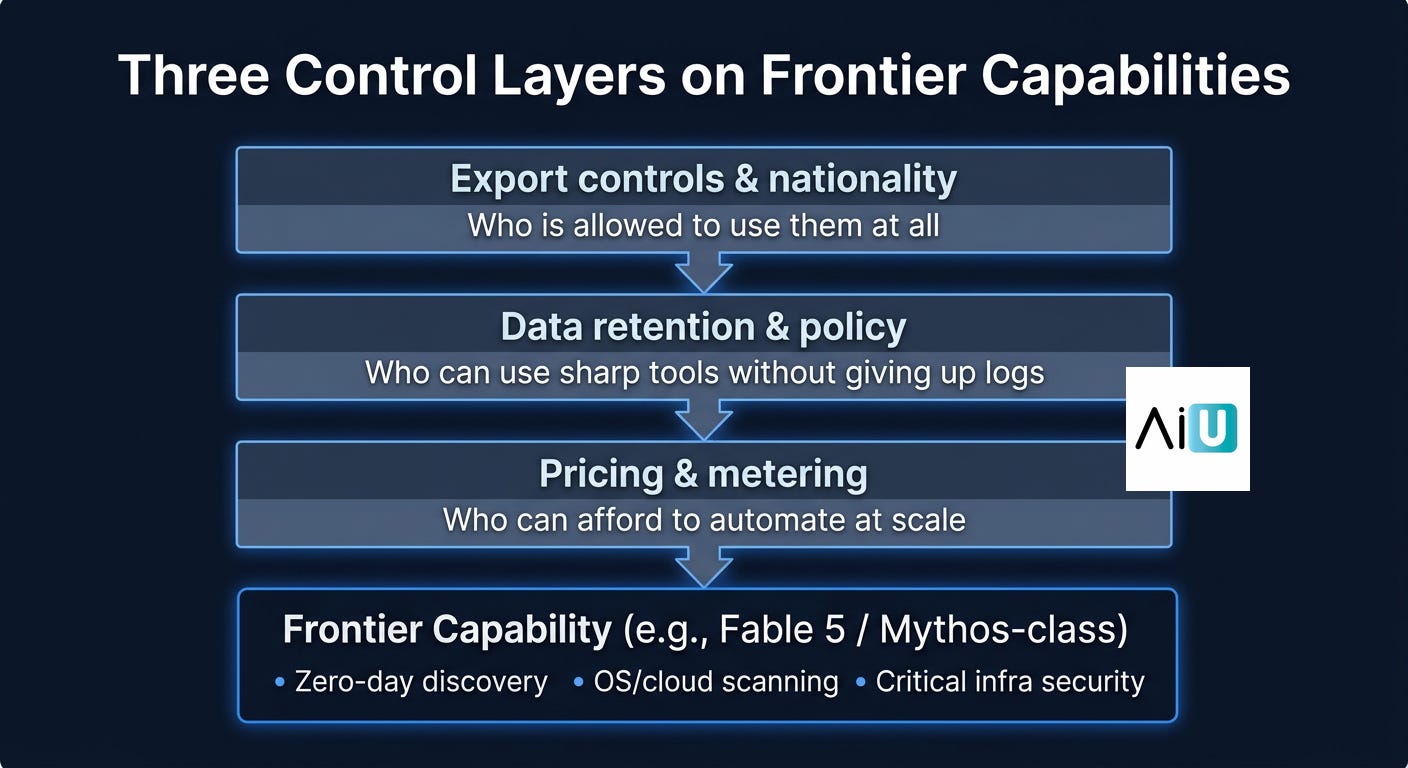
This is what frontier AI looks like in 2026:
three overlapping control layers on the same capability.
Pricing and metering – who can afford to automate at scale.
Data retention and policy – who is allowed to use the sharpest tools without giving up logs.
Export controls and nationality – who is allowed to use them at all.
We’ve moved from controlling chips, to controlling training runs, to now controlling models
themselves at the inference layer;
Fable 5 is the first visible proof that export controls have climbed all the way up the stack.
If you’re a founder outside the U.S., you just watched the third layer become real in a single news cycle.
This isn’t just Anthropic’s problem
From the outside it may look like Anthropic’s only drama. But Anthropic isn’t the only lab in this game. OpenAI, Google, DeepSeek and a growing open‑weight ecosystem are all chasing Mythos‑class cyber capability, but Anthropic is the first to have a frontier model formally yanked into an export‑control regime. That makes Fable 5 less a one‑off and more a prototype for how other frontier models -closed and open- may be treated when they cross certain capability lines.
The timing matters.
Regulators are experimenting in public with where to draw the line between “powerful tool” and “regulated capability.” Once a pattern is set like certain eval scores, certain cyber benchmarks, certain deployment patterns. all the other models that hit those thresholds can be dragged into the same regime almost automatically.
If you’re building on a competitive stack today, you’re not immune—you’re just earlier on the curve.
Why my Anthropic playbook Part 3 is delayed.
I was planning to publish the 3 part of the series on intelligent founder on sunday. for those who; din’t read the previous one focussed on -
Part 1: how Mythos and Project Glasswing turned a series of near‑disasters into a moat- security as a market, not just a cost center.
Part 2: the business map - Glasswing’s coalition, the revenue curve, where Anthropic sits against OpenAI, Google and others, and what a Mythos‑grade security model does to the rest of the market.
The Part 3 was meant to be the “everything else” chapter: the PBC structure, the investor map, the internal fractures, the China problem, the IPO window, and the next eight months. It’s the chapter about governance, incentives and how a $900B‑ish PBC behaves when quarterly earnings collide with a safety mission.
The Fable 5 shutdown doesn’t replace that story, but it changes its center of gravity.
Anthropic isn’t just shipping models. it’s rewiring how software gets built thats from Claude Code in your IDE to Mythos‑class scanners in critical infrastructure.
and It’s doing that as a Public Benefit Corporation heading toward a 2026 IPO at close to a trillion‑dollar valuation, with a charter that legally constrains how it can prioritize profit over mission and a cap table that now includes Amazon, Google, Microsoft and NVIDIA.
Whatever governance structure they lock in this year is the one public markets and regulators will inherit.
And now, for its most advanced systems, Anthropic sits under an explicit national‑security regime that can switch your most important tools off with a fax. You can’t write a serious “Anthropic governance and incentives” chapter without integrating that reality.
So yes, Part 3 is delayed. and not because the outline has changed - it’s still origin, revenue miracle, the real product, the code play, investors, efficiency, internal fractures, China, IPO, permission race. But the frame just shifted from “how Anthropic will govern itself post‑IPO” to “how Anthropic will be governed, full stop - by boards, by regulators, and by whoever gets to sign the export‑control letters. I think i’ll take a minute before i’ look in to this again.
