


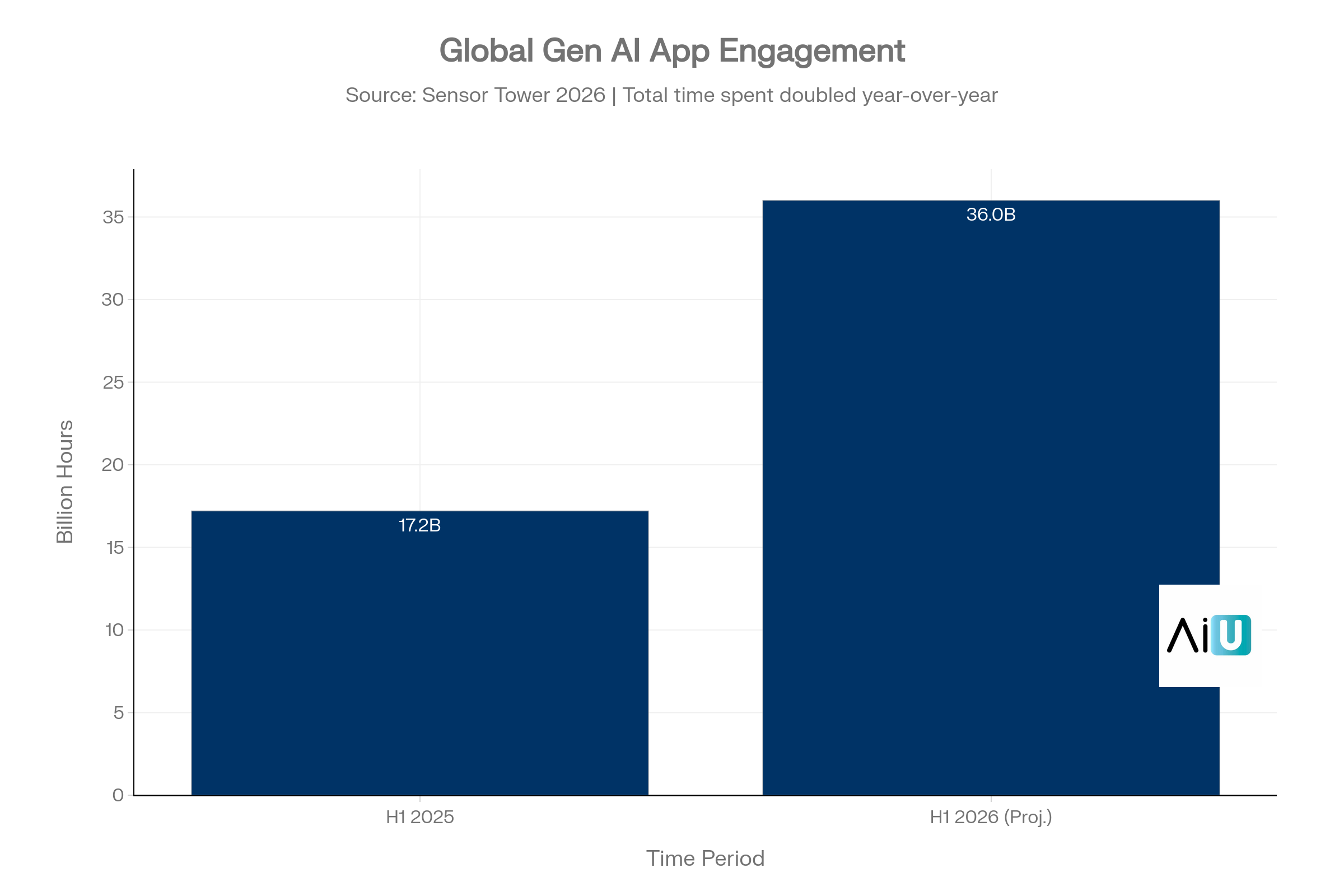
AI has very clearly eaten mobile. In just a year, global time spent in generative AI apps has roughly doubled, from 17.2 billion hours in the first half of 2025 to a projected 36 billion hours in the first half of 2026. Consumer spending has followed the same curve.
AI apps are on track to generate more than $4.2 billion in in‑app purchase revenue in H1 2026, up about 36% on the second half of last year and more than double year‑on‑year.
Across mobile overall, AI has become a core revenue engine: global in‑app purchase revenue reached around $167 billion in 2025, and for the first time non‑game apps overtook games as the main source of spend.
Within that surge, assistants still sit at the centre.
ChatGPT has become the fastest application in history to reach 1 billion monthly active users, hitting that level roughly three years after launch. It remains the largest assistant, but it no longer looks like a monopoly.
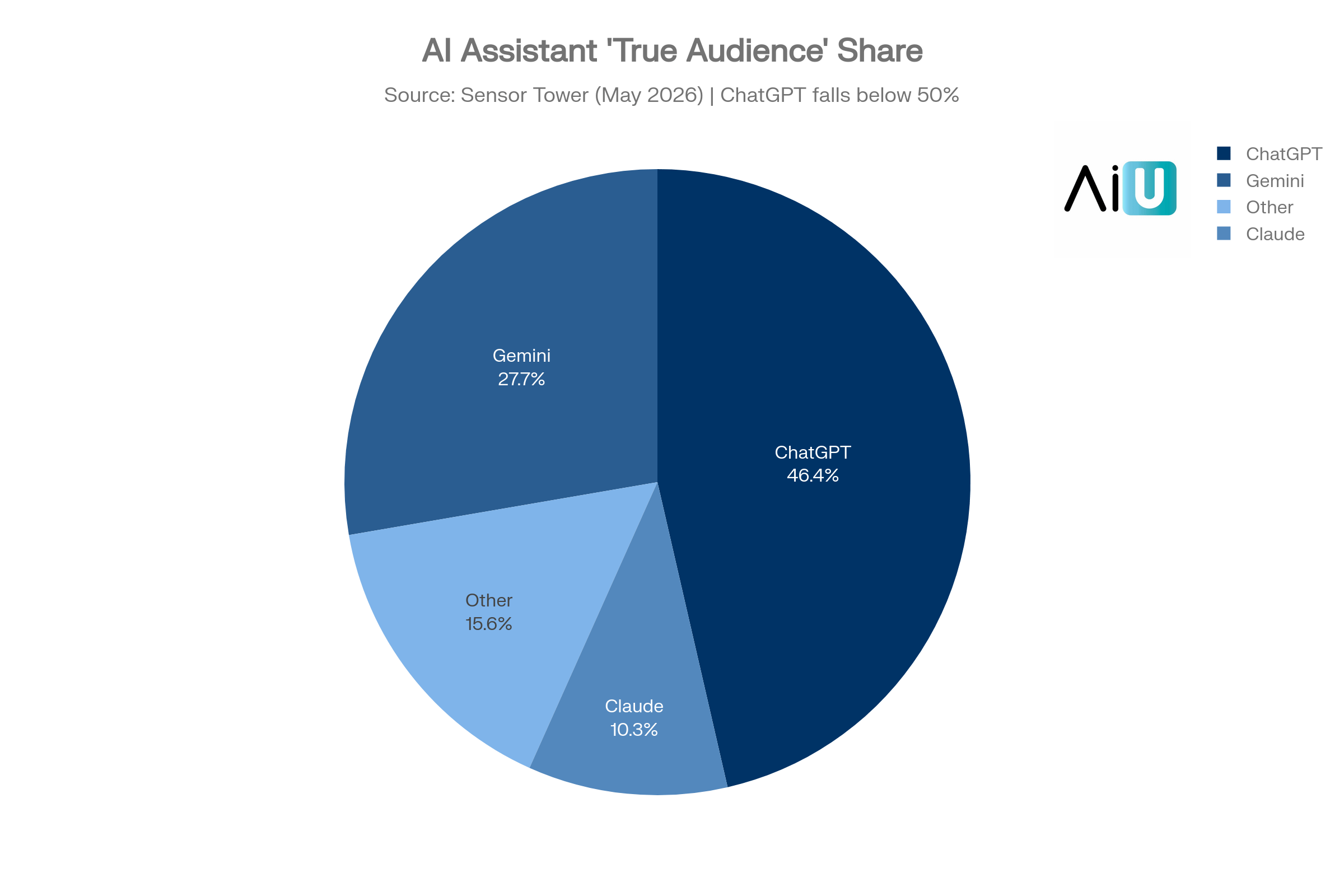
Recent data puts ChatGPT’s “True Audience” share at about 46.4% in May 2026, with Google’s Gemini at 27.7% and Anthropic’s Claude around 10.3%. Time spent is heavily concentrated in a small cluster of assistants, but the lead is now shared between several players rather than one. In practice, the assistant layer has become a three‑ or four‑player market, sitting on top of a much broader wave of AI‑branded mobile apps.
The more interesting story however, is what happens when you stop looking at sheer scale and start looking at revenue per user.
At a headline level, ChatGPT still dominates mobile revenue. Its app has generated quarterly revenue in the low billions and has out‑earned the rest of the top 10 AI apps by a factor of five or more. But on a per‑user basis, Claude now comes out ahead.
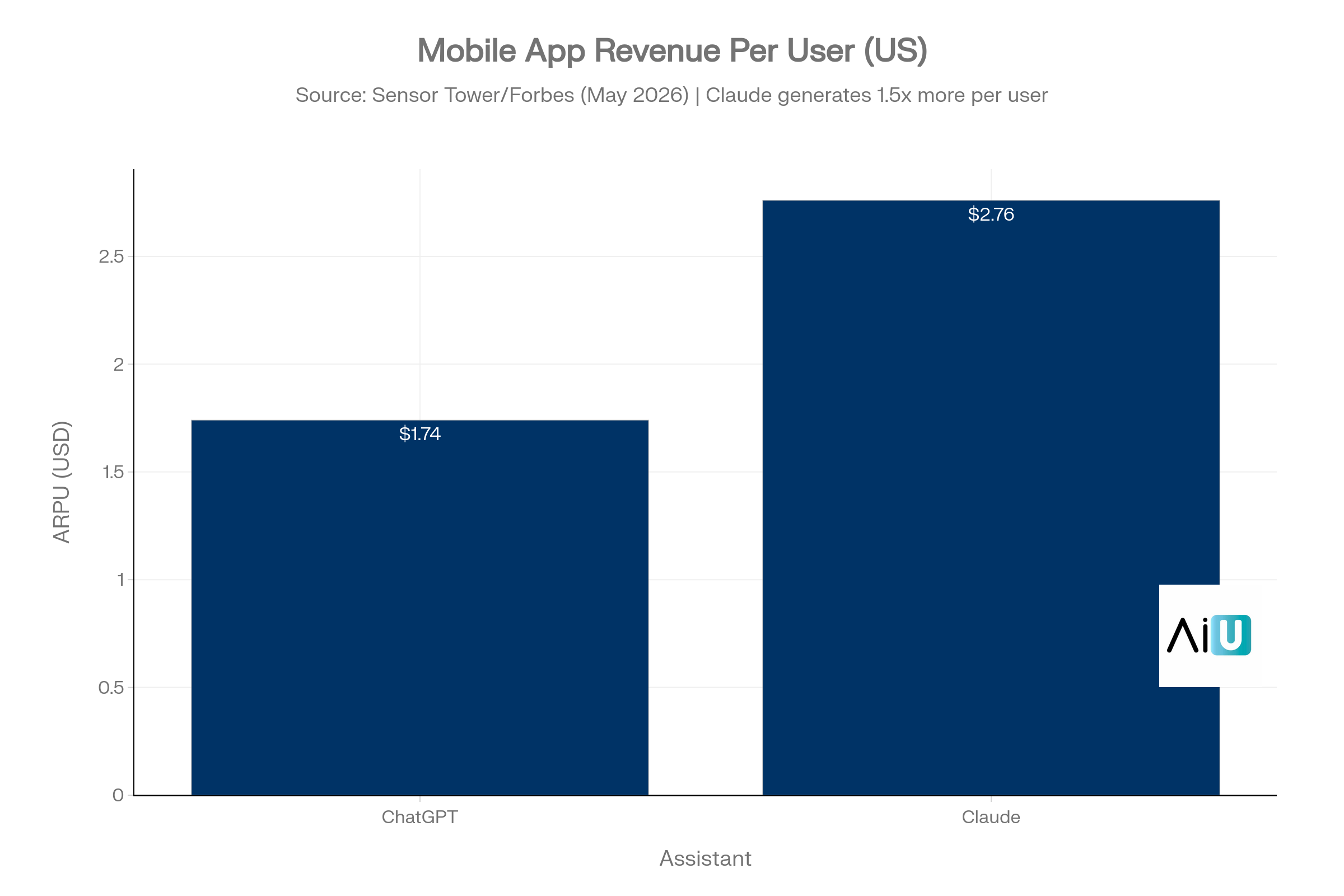
In the US, Sensor Tower data suggests that,
Claude’s iOS app earns about $2.76 per user, compared with $1.74 for ChatGPT –
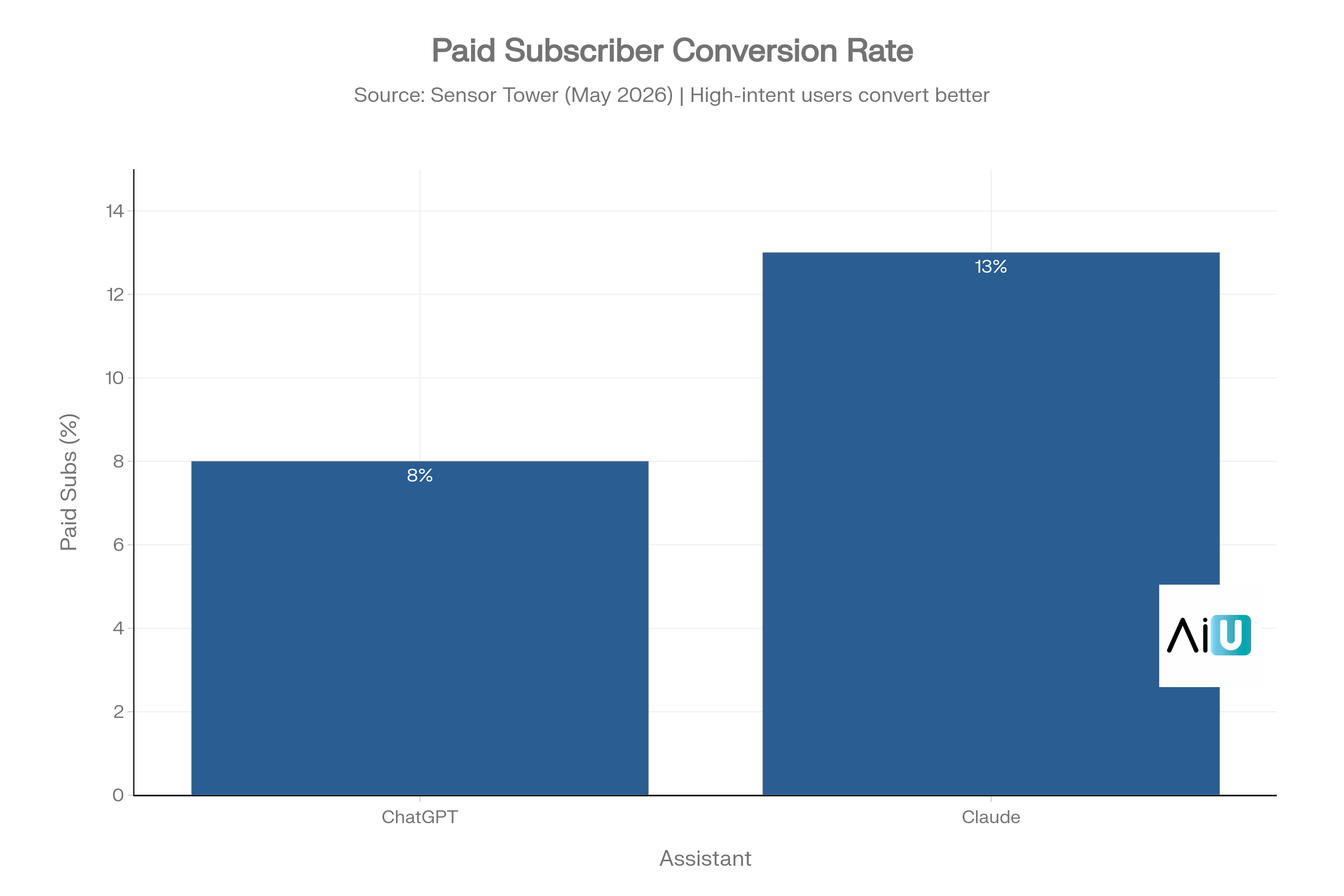
roughly one and a half times higher ARPU off a smaller user base. Claude also turns a larger share of its users into paying customers, with around 13% of iOS users subscribed versus about 8% for ChatGPT in recent snapshots.
This is a familiar pattern from other software markets.
The broad, general‑purpose product wins the biggest audience; the more focused product captures the highest‑value users.
Right now, the division of labour looks roughly like this:
ChatGPT is the default assistant for almost everyone, ( almost! ) Gemini is the deeply integrated option for people inside the Google ecosystem, and Claude is emerging as a favourite for high‑intent professional and enterprise use, where depth, safety and workflow fit matter more than novelty.
The fact that Claude can sustain higher ARPU and better conversion on fewer users is a reminder that enterprise‑style usage tends to be structurally more monetizable than mass‑market experimentation.
It also highlights how narrow the first wave of AI monetization has been.
Most of the money so far has gone into the very top of the stack:
chatbots,
writing tools,
companions,
coding assistants, and
image and video generators.
Apps that explicitly brand around “AI”, “LLM” or “machine learning” are on track to make about $12 billion in in‑app purchase revenue in the first half of 2026, with downloads up 177% versus 2023. Almost all of that activity is still about what happens on the screen – typing, reading, chatting, scrolling.
Even the first wave of ads in AI assistants follows the same pattern. OpenAI has started testing ads inside ChatGPT; by May, roughly 17% of daily users were seeing ads, and impressions had grown more than seven‑fold in a few months, mainly from software, retail and media brands.
[ While this piece is a focused, number‑driven zoom‑in on assistants/mobile and the missing infrastructure monetization, I also did an overview / bigger picture if the story is consistent out side of AI mobile, and the assistive interface being a major revenue surface here - ]
Very little of this touches infrastructure though.
None of the headline statistics are about AI planning maintenance windows or improving reliability or performance. The AI that has “eaten mobile” is mostly AI that talks, draws and recommends, and not AI that understands physical systems, reasons about risk, or optimizes interventions on the ground.
The business models mirror that focus:
consumer subscriptions,
prosumer upgrades,
usage‑based APIs on text and images, and
now ad inventory.
There is no equally visible set of metrics for AI that quietly reduces downtime, extends asset life or improves safety in the background of critical operations. take it most of the founders reading will fall in to visible category, but this is what worries me, personally.,
For founders and operators, there is both a caution and an opportunity here.
