

Amazon’s $15B AI Number is Real, But Misleading.
Breaking down Amazon’s AI run-rate headlines, the 260× claim, and why most enterprises still aren’t seeing the money.

In the last few days, a lot of posts have been circulating a line that looks roughly like this:
“The AWS AI Figure: $15B annualized. Jassy compared it to where AWS itself stood at the same stage of its growth, saying it is 260 times ahead of that pace.”
This isn’t made up. It’s a paraphrase of what Amazon and the wires are actually saying.
News outlets are running headlines such as:
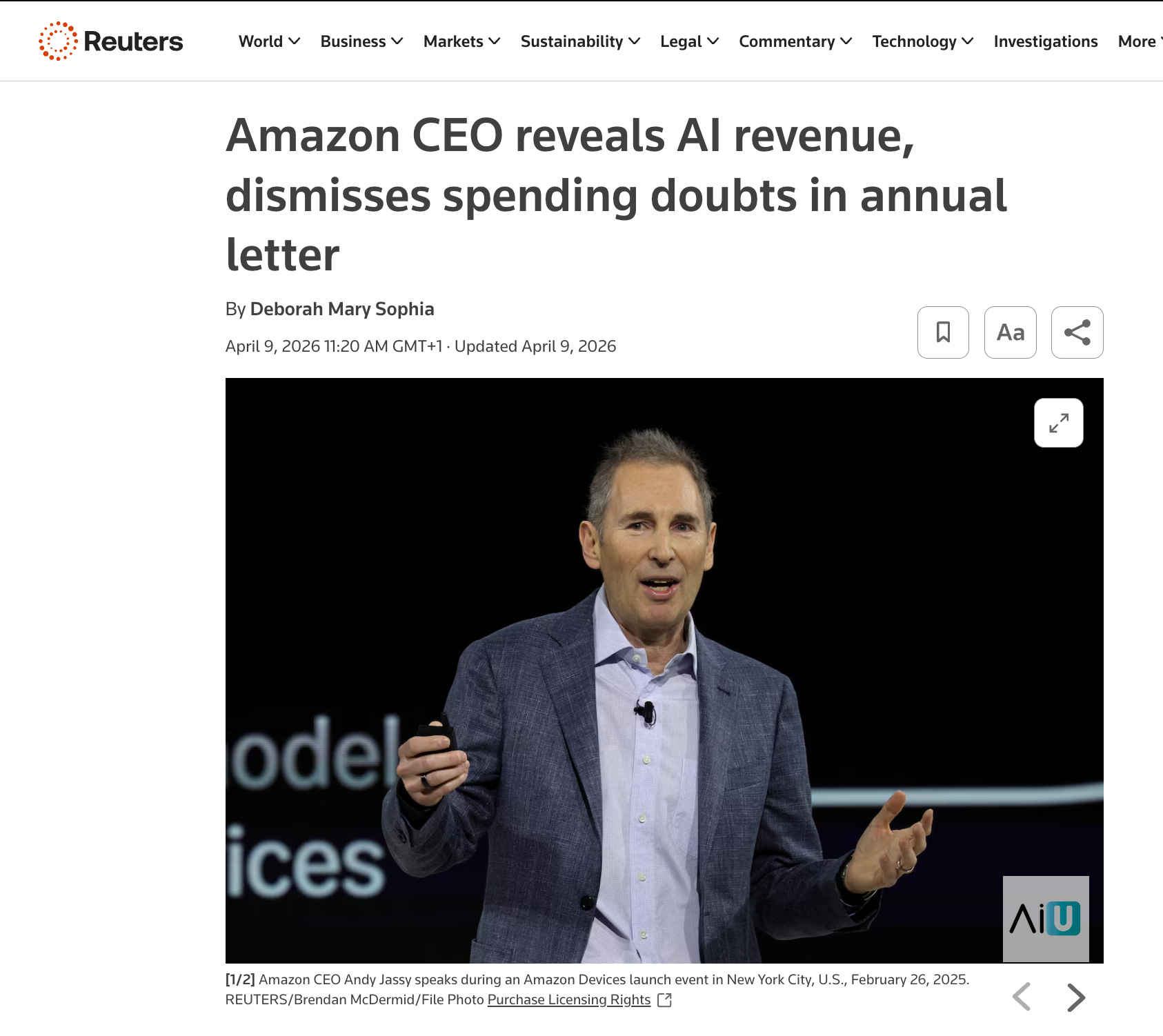
“Amazon cloud unit’s AI revenue run rate exceeds $15 billion in first quarter, CEO says”
“Amazon cloud unit’s AI revenue run rate exceeds $15 billion, CEO says”
“Amazon’s AI services at its cloud-computing unit are generating annualized revenue of more than US$15 billion, CEO Andy Jassy said”
And in coverage of Andy Jassy’s shareholder letter you get this direct framing:
“Three years after AWS launched commercially, it had a $58 million revenue run rate. Three years into this AI wave, AWS’s AI revenue run rate is over $15 billion in Q1 2026 (nearly 260 times larger than AWS at that same point) and ascending rapidly.”
So the viral summary line is basically accurate: the AI run-rate is >$15B, and Jassy really is saying it’s “nearly 260 times” the revenue AWS had at a comparable point in its early life.
The problem is how easy that is to over-interpret.
First, the $15B figure. This is a run-rate, not a neat “AI product” P&L.
If customers kept using AWS’s AI-related services at today’s pace for a full year, Amazon would pull in more than $15B from what it categorizes as AI. That bucket includes things like foundation-model APIs and ML platforms, but also a lot of the underlying cloud plumbing like compute, storage, networking, and in big part » custom chips, that those AI workloads run on.
It’s a slice of AWS usage that Amazon labels “AI,” not a single clean line item.
Second, the “260 times ahead of that pace” line is not a return-on-investment metric.
Jassy is doing a simple historical comparison:
three years after AWS originally launched, it was at $58M revenue run-rate; three years into this AI wave, the AI-tagged portion of AWS revenue is over $15B, which is nearly 260× larger.
That tells you the speed and scale at which AI infrastructure revenue is ramping compared to early cloud.
It does not tell you anything about margins, payback periods on the roughly $200B capex plan, or whether AWS customers themselves are making money with AI.
And that’s the real tension.
While Amazon is reporting that its AI revenue run rate exceeds $15B, multiple independent studies and CFO surveys suggest the majority of enterprises are still stuck in the “AI experimentation” trap—lots of pilots, very little measurable revenue or cost savings. In other words, AWS can earn billions selling the picks and shovels for AI, even if most of the miners are still digging dry holes.
Read this way, the official lines:
“Amazon cloud unit’s AI revenue run rate exceeds $15 billion, CEO says”
“AWS’s AI revenue run rate is over $15 billion in Q1 2026 (nearly 260 times larger than AWS at that same point)”
are technically correct, but incomplete.
They prove that AI infrastructure demand is exploding and that Amazon is already monetizing the experimentation phase at scale. They do not prove that AI is currently delivering strong, broad-based returns for the median customer.
For a community that actually reads past the headline, that nuance is the interesting bit. The story here isn’t “AI is solved and printing money for everyone.”
It’s:
“AI infra revenue at AWS is growing far faster than early cloud did. That’s great for Amazon. For most buyers, the hard part—turning those AI bills into real business results—still lies ahead.”
For investors, the takeaway is straightforward:
hyperscalers are monetizing AI whether or not customers crack ROI.
For operators and founders, the bar is higher:
you only “win” if you can turn that AI infra spend into durable revenue, margin, or clear cost savings.
Also worth noting: “AI revenue run rate” is a management-defined slice of AWS, not a GAAP segment (an officially defined business unit a company must break out in its audited accounts, with its own revenue, profit, and assets disclosed.) . Nevertheless, Definitions can move over time, which is great for storytelling, but makes it harder to compare like-for-like across years and providers.