



Every few months, AI Twitter invents a new version of The Matrix. This month, it is two research projects:
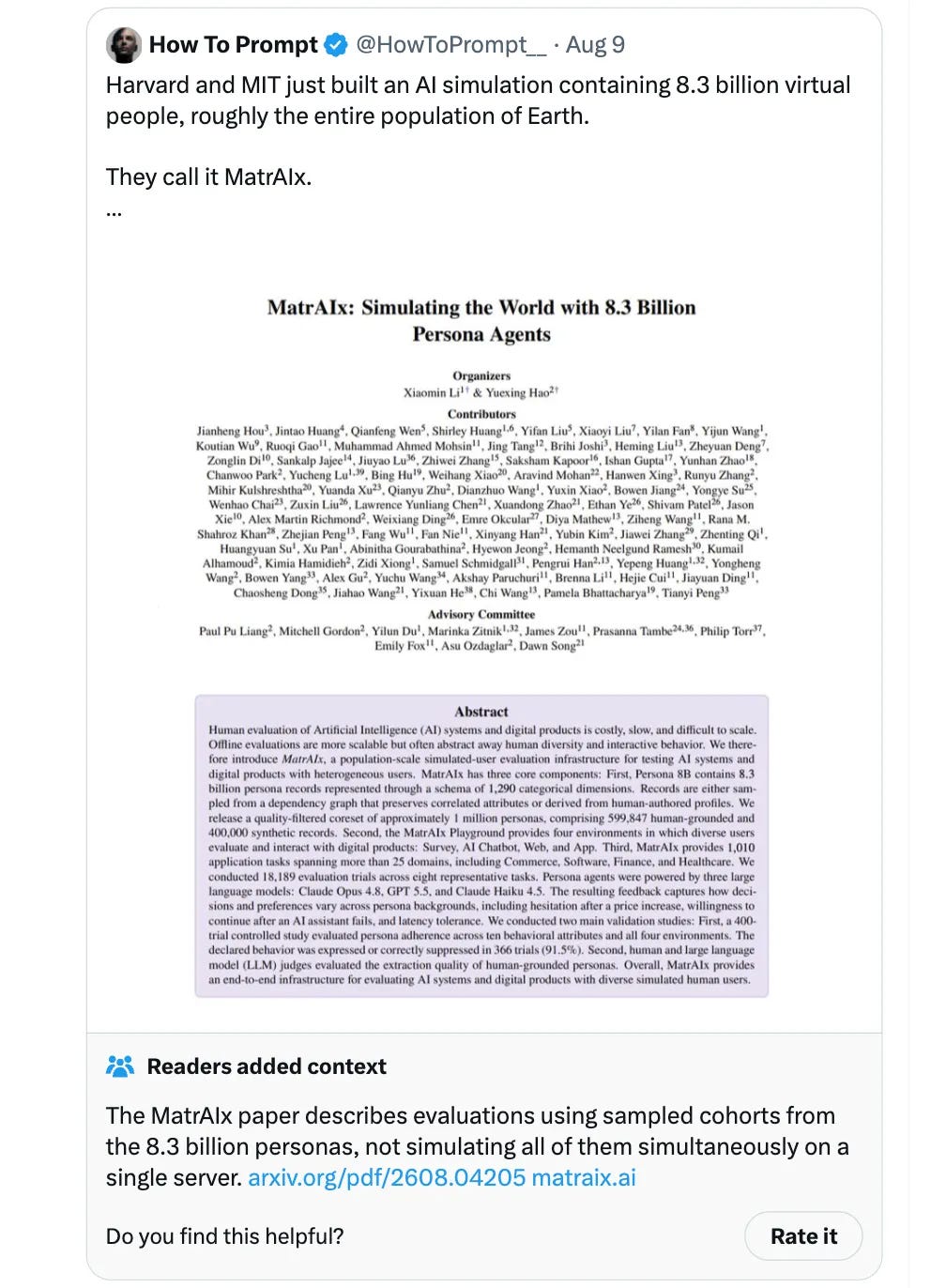
MatrAIx, framed as Harvard and MIT “simulating the entire planet” with 8.3 billion AI personas, and
Light Society, framed as China building a one-billion-agent model of society.
Both are real. Both are interesting. And both are being oversold.
The social-media version makes it sound like researchers have built a live digital twin of humanity: billions of autonomous AI people, all thinking, talking, evolving, and predicting the future. But that’s not what is really whats happening here and we should pay attention.
x full paper download here.
MatrAIx is best understood as a synthetic user-evaluation system. Its core asset, Persona 8B, is a database of 8.3 billion persona records, each described across 1,290 categorical attributes. From that giant pool, researchers or product teams can sample a cohort, instantiate those personas through an LLM, and test how they interact with a survey, chatbot, website, or app. The key point is that it does not run all 8.3 billion personas at once. Even X’s own community note had to correct the viral claim and explain that the paper uses sampled cohorts, not a simultaneous simulation of the whole planet.
That matters because the headline “simulates 8.3 billion people” suggests something far more advanced than the actual system.
MatrAIx is not a world model of humanity.
It is a product-testing and AI-evaluation framework built on top of a very large synthetic population.
Light Society is different, but it gets distorted in a similar way. The underlying paper describes a framework for simulating social processes with more than one billion agents grounded in demographic and values data derived from the World Values Survey.
Its purpose is not UX testing.
It is trying to model social dynamics such as trust games, opinion diffusion, and collective behaviour across a massive network.

So yes, Light Society is closer to a genuine large-scale social simulation than MatrAIx. But even here, the viral interpretation goes way too far.
download gthe paper here
It does not mean one billion unique, fully fledged AI minds are running in real time.
Reporting and technical analysis suggest that at full scale the system relies on a mixture-of-models design and precomputed lookup-style interaction rules, rather than live frontier-model inference for every agent in every interaction.
There is another important catch.
The billion-agent Light Society runs are reportedly built from a much smaller base of World Values Survey profiles that are replicated across the network. In other words, there may be one billion agent instances, but not one billion individually unique, richly modelled personalities. That is still a substantial engineering achievement. It just is not the same thing as simulating one billion real people.
This is the pattern with both projects. The science is interesting. The headline is doing too much work.
MatrAIx is basically saying:
can we create a fast, repeatable synthetic-user layer before spending time and money on real surveys, UX research, and product testing?
That is genuinely useful.
A product team could test onboarding flows, chatbot behaviour, price sensitivity, or feature messaging against simulated cohorts before recruiting human participants.
The released Persona 1M subset and open-source Playground make that direction more concrete than a lot of synthetic-user demos.
Light Society is asking a different question:
can we simulate large-scale social behaviour with richer agent rules than traditional agent-based models?
That is also useful. It could help researchers study how trust, beliefs, or rumors move through a stylized population, and explore hypotheses about emergent collective behaviour at scales older social simulations struggled to reach.
But neither project should be confused with a reliable engine for predicting society.
A synthetic cohort can be internally consistent without being valid. A billion-agent simulation can produce elegant patterns without being predictive. And a huge number of personas or agents can create the illusion of scientific certainty even when the whole system rests on fragile assumptions.
For MatrAIx, the key risk is treating synthetic users as a replacement for real people. The creators themselves frame it as infrastructure for simulated-user evaluation, not a substitute for actual human research. That is the right framing. It may reduce the volume of low-end survey work and speed up early product validation, but it cannot replace field interviews, representative polling, or high-stakes user research where lived experience and real behaviour matter.
For Light Society, the risk is different. It is easier for people to mistake a stylized social simulation for an instrument of prediction or control. Once you attach phrases like “planetary scale,” “one billion agents,” and “human-like society,” people jump straight to elections, public opinion shaping, and information warfare. Some of those concerns are not crazy. But the evidence so far points to a hypothesis engine, not an oracle.
So what should founders actually do with all this?
A practical playbook for founders
Ignore the sci-fi framing. These are not digital twins of humanity. they are useful but limited simulation and evaluation tools.
Use synthetic users early. Test product concepts, onboarding, chat flows, messaging, and obvious failure points before paying for real-user research.
Validate the important things with people. Use simulations to narrow hypotheses, then run smaller, focused studies with real users before high-stakes decisions.
Watch MatrAIx for product-testing infrastructure. The signal is faster, repeatable pre-validation for AI products and digital experiences—not the replacement of user research.
Watch Light Society for social modeling. Its value is in testing how beliefs, trust, and narratives may move through networks, not reliably forecasting or controlling society.
Borrow the architecture, not the headline. Define who is being simulated, what assumptions are built in, and what decision the simulation can actually inform.
Track inputs and limitations. Record the source data, persona design, base model, network assumptions, and prompt or policy changes; otherwise, you cannot tell whether a result reflects users or your system’s own biases.
Measure against reality. The only meaningful test is whether simulation outputs later match real behaviour, research findings, or product outcomes.
Treat results as decision support, not evidence of truth. A large number of synthetic agents can generate highly confident-looking results without making the underlying assumptions more accurate.
That is where the value is.
Not in pretending we have built The Matrix, but in building better tools for testing ideas before reality does it for us.
Read the latest on Intelligent founder and Quantopinion.

