

Frontier AI Right Now: Big Brains, Small Models, and Smarter Tools
Why the latest “frontier” models matter less than how developers and enthusiasts actually wire them into real‑world agents, apps, and everyday workflows.


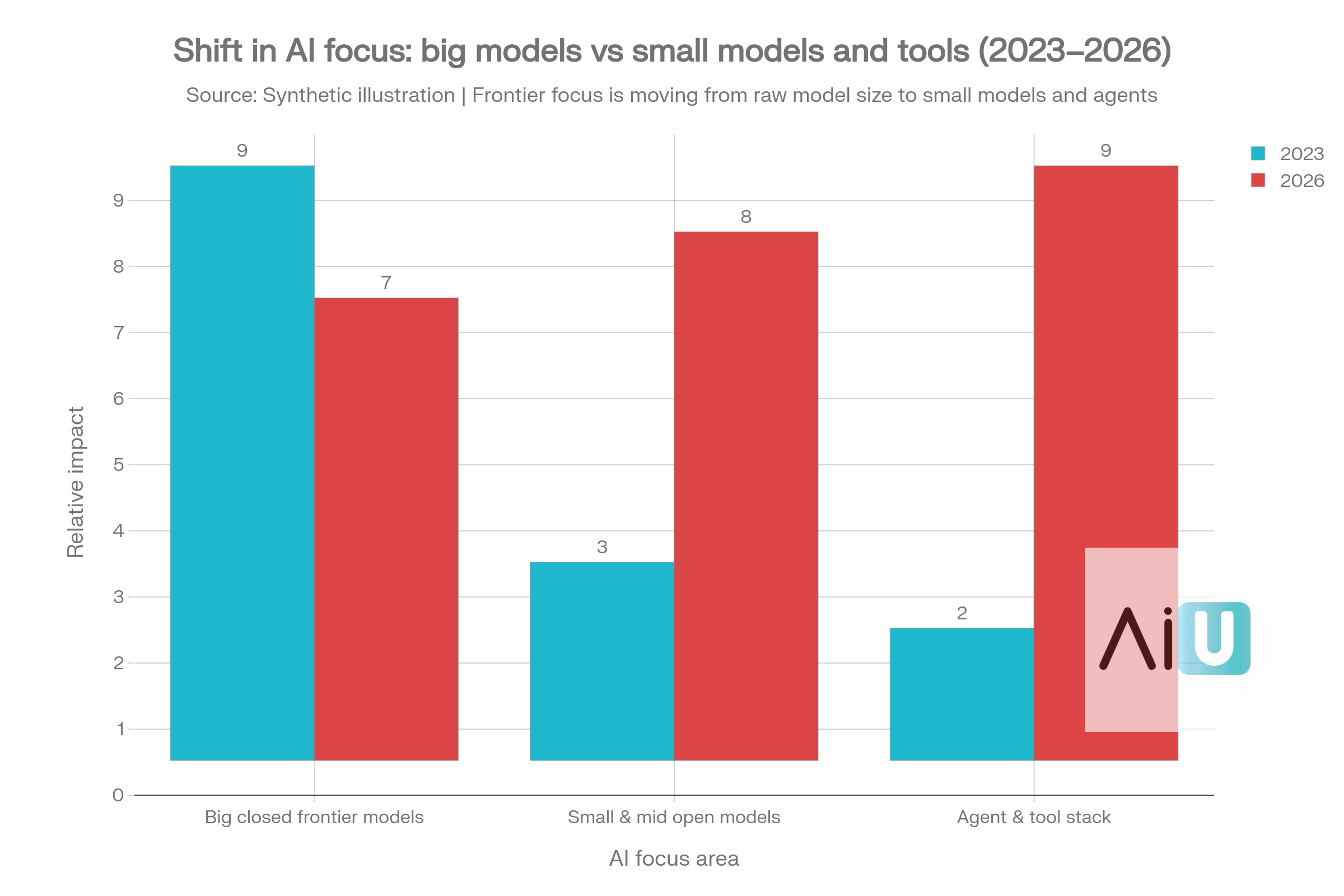
What’s happening right now in AI is that the “frontier” part meaning the most powerful general‑purpose models, has hit a kind of plateau, while the action is shifting into two places:
smaller open models you can actually run yourself, and
better tools that turn any model into a useful assistant or “agent.”
In other words, the headline isn’t just “models are getting bigger,” it’s “models are getting good enough, and everything around them is getting smarter.”
So what’s actually going on?
If you look at benchmarks and trackers, the newest top models (GPT‑5.x, Claude Opus 4.x, Gemini 3 Pro and friends) are only a bit better than last year’s versions across lots of real‑world tests, researchers describe them as topping out around a “C+” level on broad exams. That’s impressive, but it’s not a leap to omniscience, it’s more like going from a strong student to a slightly stronger one.
At the same time, industry analysts are noticing that the growth in the largest frontier models has slowed sharply, while “small” and mid‑sized models are exploding in number and use. These smaller models are still very capable, they cost less to run, and they’re much easier to deploy on regular hardware such as laptops, consumer GPUs, edge boxes.
Why is this happening?
There are a few big reasons.
First, bigger isn’t automatically better anymore.
The Stanford AI Index and other evaluations show diminishing returns: doubling parameters or training data doesn’t double real‑world usefulness. Frontier models are bumping into practical limits like training cost, data quality, and the fact that a lot of tasks now bottleneck on reasoning or domain knowledge rather than just raw scale.
Second, open‑source is catching up fast.
Open models like Llama, Qwen, Mistral and others are now good enough that, when you fine‑tune them on your own data or wrap them in smart retrieval/agent setups, they rival closed models on many specific tasks. That shifts power from a few labs to a broader builder ecosystem: anyone who can engineer a decent stack can stand on roughly similar model quality. and,
Third, hardware and money matter.
Training ever‑bigger frontier models costs eye‑watering sums and demands specialized clusters, while small/mid models can hit “good enough” performance while fitting into the budgets and infra of normal companies. Investors and infra teams are starting to ask: why chase a tiny accuracy gain if a smaller model plus good tooling delivers most of the value?
Where do “agents” and tools fit in?
This is where tools and agents come in.
The story in 2026 isn’t just “a smarter brain,” it’s “a brain that can use tools.”
Agent frameworks (LangChain, AutoGen, PydanticAI, LangGraph, OpenAI/Anthropic/Google agent SDKs) and no‑code builders (things like Lindy, Flowise, and other automation platforms) let you wire models into actions: browsing, calling APIs, updating calendars, querying your own documents, running code. You can also orchestrate multiple agents with different roles, pass context between them, and fall back to humans when needed.
The net result?
a “merely good” model plus a well‑designed agent and tool stack often beats a “frontier” model used as a raw chatbot. That’s why you’re seeing so much hype around AI copilots, workflow bots, and multi‑agent systems - the value is in the system, not just the core model.
What does this mean for developers and enthusiasts?
For developers, this moment is oddly empowering. You don’t have to train a giant model to do interesting work; you can choose from:
Big hosted models (easy to start, pay‑per‑use, great for prototypes).
Open models you can run locally or in your own cloud (more control, better for privacy, cheaper at scale).
Then you wrap whichever model you pick in agent tooling for example, LangChain for Python, or a no‑code agent builder, and suddenly you’ve got something that can move data around, call services, and actually perform tasks, not just chat. That’s a huge shift from just a couple of years ago, when only big labs could play at this level.
For enthusiasts, the same trend means you can experiment with “frontier‑style” ideas on a gaming PC or even a powerful laptop.
You can run an open model locally, hook it up to a small agent framework, and start building personal automations, research assistants, or creative tools that never leave your machine.
What does it mean for founders and product builders?
For founders and product teams, this landscape is both a gift and a trap.
The gift is leverage:
thanks to ready‑made models and agent frameworks, you can build something genuinely useful in weeks, not years, and compete in spaces like support, analytics, research, and coding tools with a small team.
The trap however is dependency:
if your whole product is “a thin wrapper over one proprietary frontier model,” you’re at the mercy of that vendor’s prices, rate limits, and roadmap.
That’s why you’re seeing a lot of advice around “model‑agnostic” or “portable” design like keep your own data, business logic, and orchestrations separate, and treat models (closed or open) as swappable components behind an abstraction layer.
Then you can start with a big hosted model for speed, move parts of your workload to open models for cost or privacy, and switch vendors if the economics or policies change.
In that sense, the real frontier now is not just training the biggest brain, but building flexible, tool‑using systems around brains that are already surprisingly capable, whether they’re closed, open, huge or small.