

Intelligence is getting cheaper, but the chips and memory behind it aren’t - and Apple’s new AI era is the clearest proof.
Behind Apple’s sleek AI features lies a global chip crunch that turns “cheap” intelligence into pricier devices.

AI was supposed to be the great deflation engine of software. Instead, it’s making your Mac more expensive.
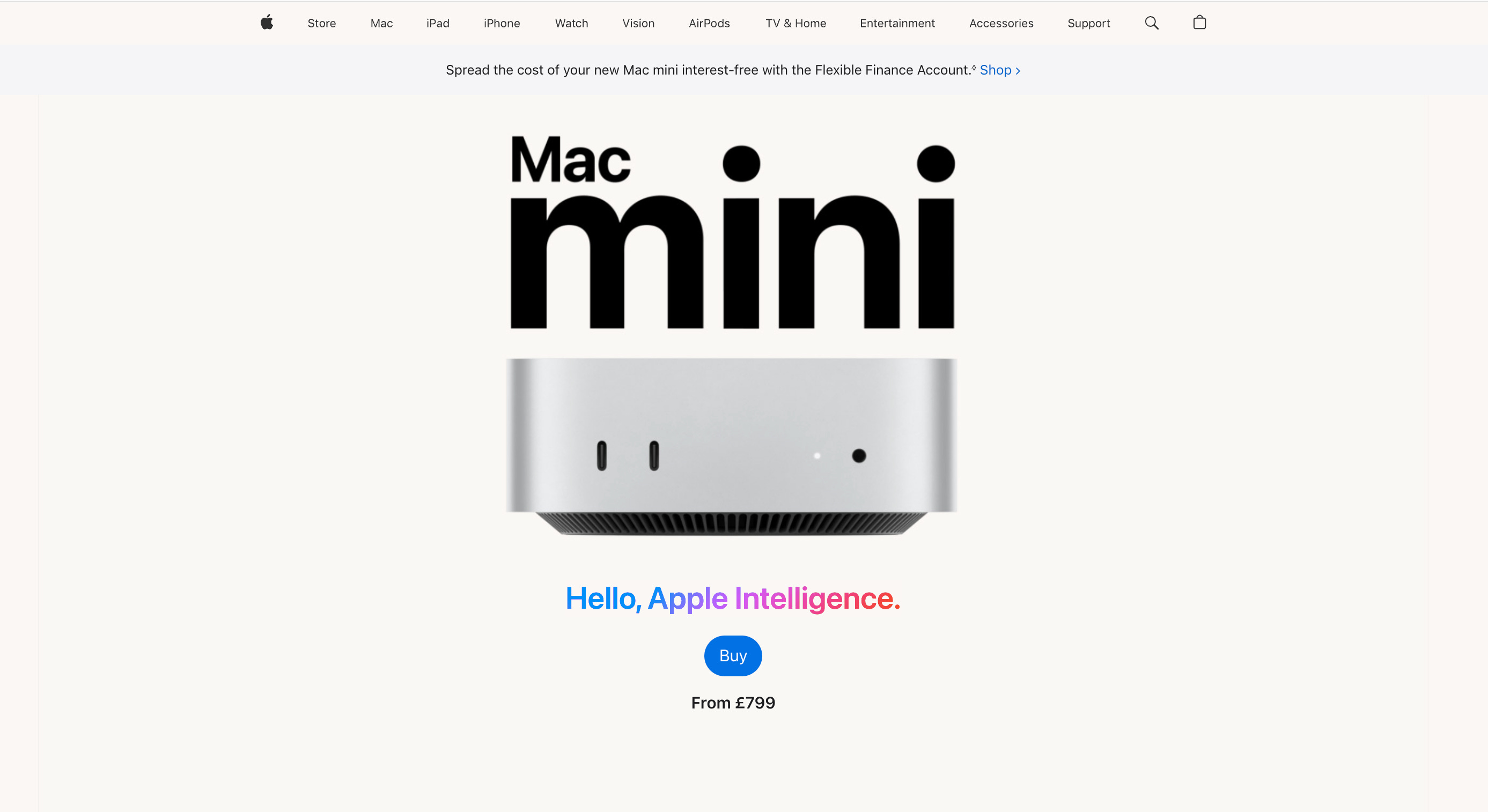
We’ve entered a strange moment where intelligence is cheap, but the atoms underneath it are not. The cost of generating a million tokens of text or code has fallen dramatically, yet the silicon, memory and data‑center capacity required to do that at scale are driving a new wave of hardware inflation.
You’re paying less for thinking and more for the chips that think.
and Apple is a perfect example of this paradox.
On one hand, Apple Intelligence and highly‑optimized on‑device models make “AI per device” remarkably inexpensive once the hardware is in your hands: marginal inference cost on an M‑series chip is close to zero, and a single purchase gives you years of local AI runtime.
On the other hand, Apple is openly blaming AI for higher MacBook and iPad prices, because DRAM and storage costs have spiked thanks to AI data‑center demand, and its own multibillion‑dollar AI investments now have to be recouped through the hardware line.
So the real question isn’t “Is AI cheaper?”
It’s “Which part of AI are we talking about?” Compute per token is racing downwards; the bill for GPUs, memory, energy and long‑term R&D is racing upwards. Apple’s choice to lean into on‑device AI while quietly raising Mac prices is one of the clearest signals that those two curves are crossing in public - for the first time, the global AI boom shows up directly on your receipt.
Where AI is getting cheaper
If all you look at is the unit cost of intelligence, AI looks astonishingly cheap.
The big model labs have spent the last few years driving down the cost of inference:
smaller distilled models,
“nano” tiers,
mixture‑of‑experts routing, and
multi‑token prediction
all mean you can generate long answers, code and images for pennies. For many users, a flat subscription around the cost of a streaming service now buys a general‑purpose assistant that would have been unthinkable at that price just a few years ago.
Under the hood, this is a classic scale story. Hardware throughput improves, software gets more efficient, and the market pushes providers to squeeze more tokens out of the same silicon budget. From a purely economic perspective, the “intelligence per pound” curve is bending down and to the right. For startups and enterprises, this shows up as workflows that can be automated or accelerated at a falling cost per unit of work: document review, reporting, prototyping, code scaffolding.
For Apple, the cheapest AI it will ever run is the AI it can run on your device. Once you’ve bought an M‑series chip, Apple can deploy small, highly tuned on‑device models, compressions of larger systems that are good enough for everyday tasks, without paying for cloud GPUs on each query. The incremental cost of another suggestion, rewrite or Siri improvement is vanishingly small compared to the one‑off sale of the hardware. That’s a genuine AI deflation story: better features, more intelligence, and almost no per‑use cost.
Where AI refuses to get cheaper
Zoom out to the infrastructure layer and the picture flips.
Training frontier models still costs tens or hundreds of millions once you add together chips, data centers, talent and energy. As models grow, you need more GPUs, more high‑bandwidth memory, more exotic packaging. Those parts have not followed the old “Moore’s law plus volume discount” narrative; instead, they’ve become constrained, expensive resources that everyone in the industry is competing to buy.
The AI data‑center build‑out has created a new demand shock for chips.
Memory manufacturers, wafer fabs and packaging houses are suddenly feeding AI servers that need enormous amounts of DRAM and fast storage. That demand spills over into consumer devices:
there’s only so much high‑performance memory to go around, and if hyperscalers pay top dollar for it, laptops and phones inherit the higher baseline prices.
This is where Apple’s story gets interesting. The company has spent heavily to catch up in AI, new silicon generations with “built‑for‑AI” marketing, custom foundation models for Apple Intelligence, and its own server infrastructure to avoid renting everything from Nvidia‑powered clouds. Those investments don’t just vanish, they have to show up somewhere, and for a hardware company the most obvious place is the price tag.
Apple’s AI pivot on your receipt
The recent wave of Apple price commentary is a subtle but important shift.
When Apple raises MacBook and iPad prices and points directly to memory and storage costs, it’s drawing a line between the global AI boom and everyday hardware.
DRAM prices have jumped sharply, with forecasts of further increases as AI build‑outs continue. At the same time, Apple needs to ship devices with more memory to support on‑device AI features; the system requirements for local models are higher than for a traditional, non‑AI OS. More RAM per device, at a higher price per chip, is a simple inflation equation.
In parallel, Apple Intelligence is being framed as a major strategic investment, not a side feature. Training and serving its own models, integrating them into every layer of the ecosystem, and building AI‑aware silicon generations all carry long‑term cost. Even if Apple’s vertical integration lets it avoid some of the GPU tax that pure software companies pay, it still has to earn back that R&D over millions of devices. The easiest way to do that is to raise, or at least hold, hardware prices while adding AI capabilities as justification.
From the user’s point of view, that’s the paradox in action.
Your new Mac is “more AI” than the last one and can run smarter features on‑device, often at no explicit per‑use fee.
But the machine itself is more expensive precisely because AI has made memory and compute a more contested resource in the wider economy. The end of cheap AI at the infrastructure level is turning into the end of cheap consumer hardware.
Two curves, one strategy
Put all of this together and you get two diverging cost curves:
The cost per unit of intelligence—per token, per answer, per assisted workflow—is falling as models, chips and software improve.
The cost of building and supplying that intelligence at scale—hardware, energy, data centers, long‑term research—is rising, especially for frontier systems.
Apple’s approach is to sit at the intersection: push as much AI as possible onto devices, where it can amortize cost over hardware sales, while accepting higher component prices and passing some of that through calmly but firmly.
For founders and policymakers, that’s a useful signal: AI is not “cheap” or “expensive” in the abstract; it’s cheap in the margins and costly in the infrastructure.
The strategic move, whether you’re Apple or a deep‑tech startup, is to design around that split.
Put the intelligence where it’s cheapest and most controllable—
edge devices, small distilled models, efficient pipelines , and be very selective about when you pay the premium for heavy infrastructure and frontier capability.