

Nvidia, OpenAI And The Codex Playbook: How Not To Become Someone Else’s Case Study!
What Nvidia and OpenAI’s Codex rollout really teaches founders about power, lock‑in, and leverage.

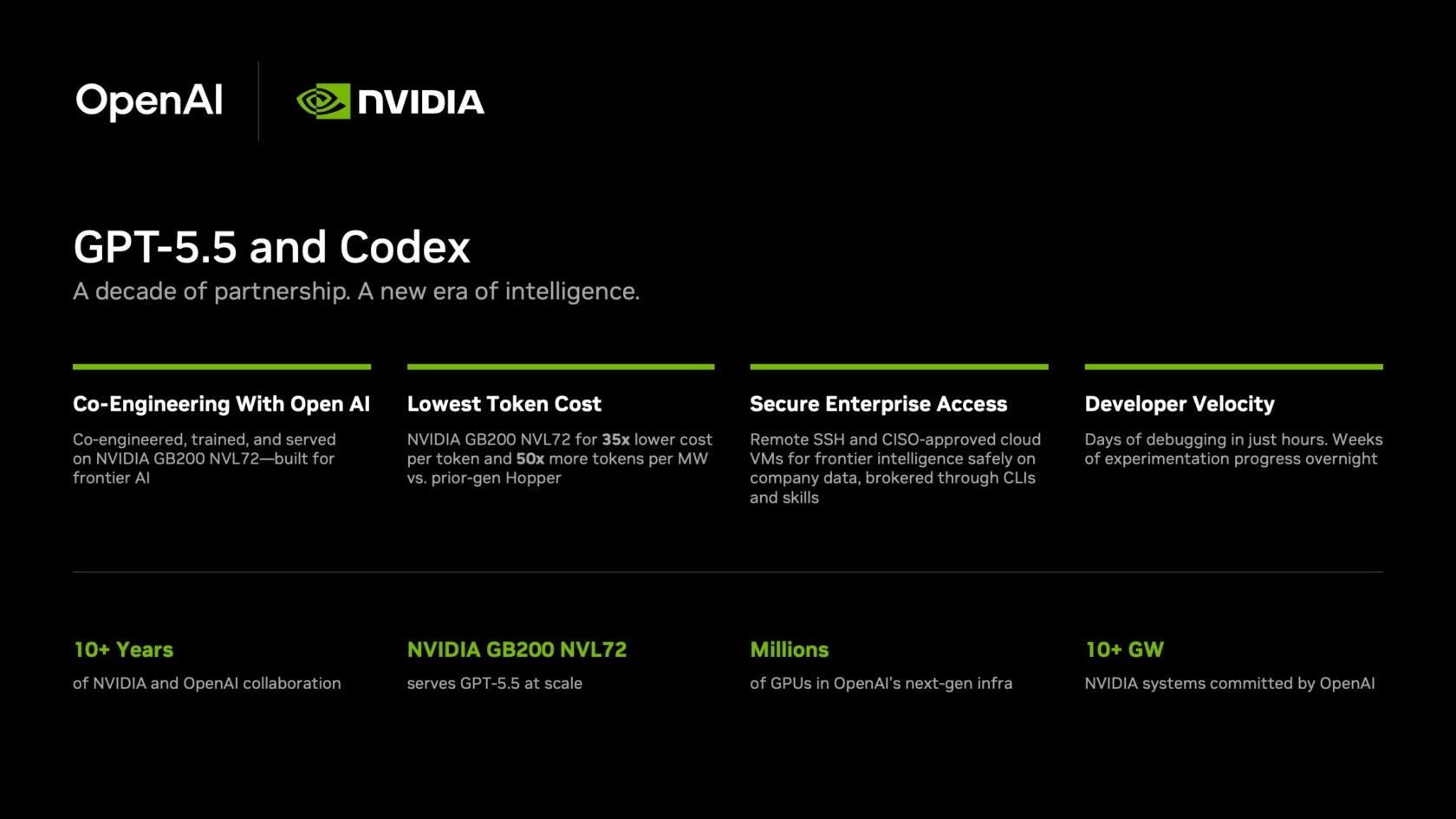
When Nvidia rolls out OpenAI’s Codex to 10,000 employees, it’s not just another “AI boosts productivity” headline. It becomes a coordinated play between Nvidia and OpenAI to lock in hardware, models and workflows at scale, and then sell that pattern to everybody else. and thats exactly how founders should be reading it like -
a playbook.
What exactly happened?
on April 23rd 2026, Sam Altman posted an internal email from Nvidia CEO Jensen Huang announcing that OpenAI’s Codex, powered by GPT‑5.5, was now available to every Nvidia employee.
Huang described Codex agents as “teammates” and “superpowers” for teams across engineering, legal, finance, HR, and marketing, and Altman added:
We tried a new thing with NVIDIA to roll out Codex across a whole company and it was awesome to see it work. Let us know if you’d like to do it at your company.
hmm.
Codex At Nvidia - More Than Autocomplete?
Inside Nvidia, Codex didn’t arrive in a greenfield. Engineers have already been using a customized version of Cursor at massive scale, with claims of roughly 3× more code being produced and shipped. Claude‑based tools are also in circulation for deep reasoning work.
Codex shows up as:
An agentic layer on top of that, a GPT‑5.5‑based system that can plan, call tools, and execute multi‑step workflows across engineering, legal, finance, HR and marketing.
A unifying metaphor - “AI workers” as teammates embedded into daily work, rather than just smarter autocomplete in the IDE.
Lesson for founders?
stop asking “Codex or Claude or Cursor?” and start designing a stack. You want:
One or two cheap, predictable “daily driver” assistants for routine coding and docs.
One or two high‑end agents reserved for the hardest work (architecture, hairy debugging, complex analysis).
An orchestration layer you own. scripts, services, internal tools, not just one baked into a vendor’s black box.
OpenAI’s Move? Turning Nvidia Into A Product Demo
Sam Altman didn’t just quietly ship Codex to Nvidia. He posted -
“if any other company wants to do this, get in touch.”
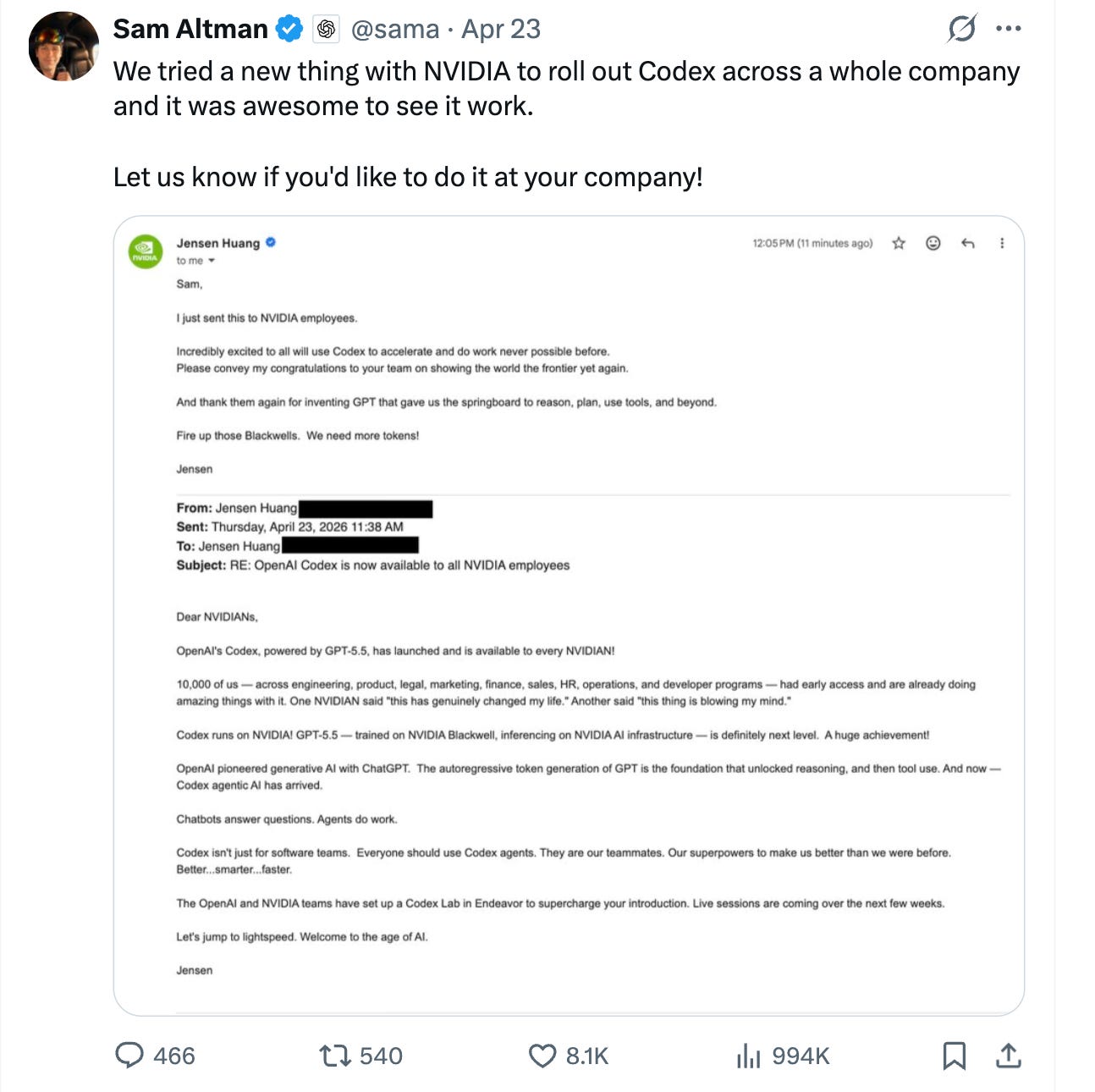
Crucially, he also shared Jensen Huang’s internal email:
Huang tells all Nvidia staff they now have Codex access and urges them to treat Codex agents as “teammates” and “superpowers” across every function.
He frames it as a cultural shift: he wants employees to “stop just coding and start orchestrating AI workers” across the business.
Notice the keywords here?
From OpenAI’s perspective, this does three things:
Social proof: If Codex works at Nvidia at that scale, it must be “enterprise‑ready.”
Template: “Whole‑company rollout + CEO email + training + metrics” becomes the default Codex deployment pattern.
Lead gen: The “any other company want this?” line is an open invitation to CEOs to sign up for the same program.
Lesson for founders?
if you let a vendor run a Codex‑style rollout for you, assume you’re signing up not just for a tool, but to be the next case study slide.
Nvidia’s Incentives? Capex Marketing And Workflow Lock‑In
In parallel, if we look at Nvidia’s balance sheet?
Huge commitments, up to tens of billions of dollars, in compute, infrastructure and funding tied to OpenAI.
A deep partnership with Anthropic, plus a major investment in Cursor, whose team publicly brags about 30,000 Nvidia devs relying on their agentic IDE.
Every Codex success metric (faster debugging, more code, faster experimentation) is doing triple duty:
Making OpenAI’s frontier models look indispensable.
Making Nvidia’s GB200/Blackwell racks look like the obvious place to run those models.
Making the Nvidia–OpenAI–Cursor triangle look like the “serious” stack for any large enterprise.
At the same time, Huang’s “orchestrate AI workers” push rewires Nvidia’s workflows around these specific agents and their behaviour. Once your SDLC, docs, legal templates and internal playbooks assume Codex/Cursor/Claude patterns, switching is no longer just an API change. It’s an organizational change.
Lesson is the same, and something i feel like i keep repeating now. -
the real moat here is workflow lock‑in. The more deeply a single vendor’s agents are wired into how your company works, the less leverage you have later.
4. What Founders Should Copy (And What To Resist)
The interesting part is Nvidia doesn’t actually live on a single tool.
They run Codex, Cursor and Claude side by side and talk about “multiple AI co‑workers,” not one magic agent. That gives them optionality:
If one model family falls behind or runs into regulatory trouble, they can rebalance workloads.
They negotiate with each vendor from a position of strength. so everyone wants to be the headline in the next productivity story.
What you should copy?
Portfolio mindset: design your stack so at least two different model families can do real work on real workloads.
Owned orchestration: keep prompts, workflows, and routing logic in your code, not in someone else’s proprietary “AI workspace.”
Benchmark habit: whenever a new agent launches, run the same small, real benchmark on your repos - same bug, same refactor, different tools.
What you should resist?
Letting any vendor run a “10,000 employees, one agent” style rollout without guardrails.
Allowing your CEO email and internal strategy decks to turn into someone else’s marketing collateral by default.
Designing workflows that assume a single tool or model is permanent.
5. A Founder’s Codex-Style Rollout Checklist
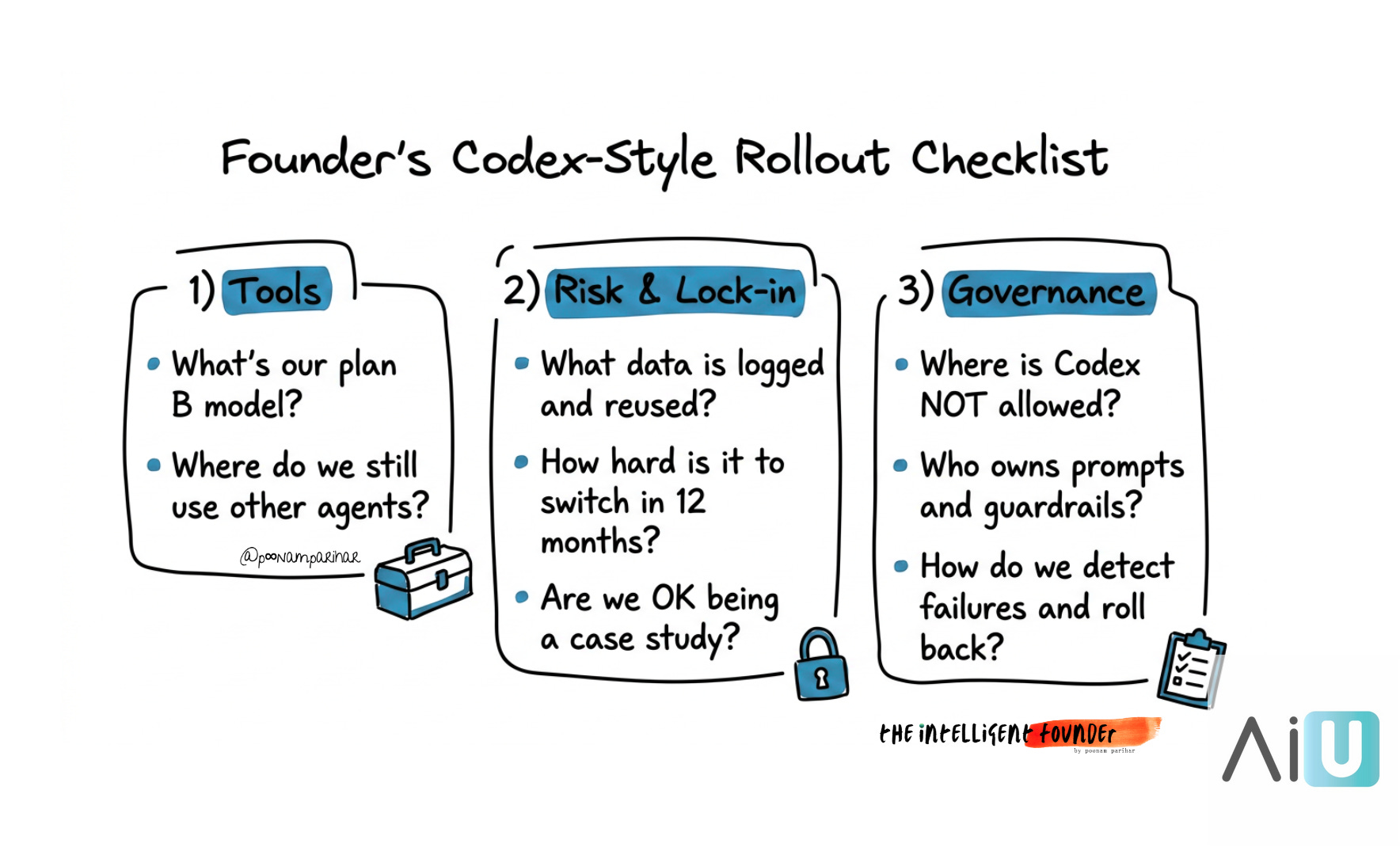
Before you say yes to an OpenAI‑ or Nvidia‑style Codex rollout, ask yourself the following. -
Tooling: What’s our second option if Codex becomes too expensive, too constrained, or politically risky?
Data: What exactly is logged, fine‑tuned on, and shared with vendors when we use Codex across the company?
Lock‑in: How hard would it be to switch 12 months from now? What would we have to rewrite?
Story: Are we comfortable being a named case study? If yes, what terms, what metrics, what NDAs?
Scope: Where do we not use Codex (e.g., safety‑critical decisions, sensitive negotiations, IP‑heavy architecture)?
Governance: Who owns prompts, guardrails and approvals? How do we detect and roll back failure modes?
Codex at Nvidia isn’t just about generating code faster. It’s about who owns the “AI worker” layer of the modern company. OpenAI and Nvidia are playing that game together, with carefully coordinated emails, tweets, and investment flows. As a founder, your job is to make sure that whatever stack you adopt increases your leverage, not theirs.