
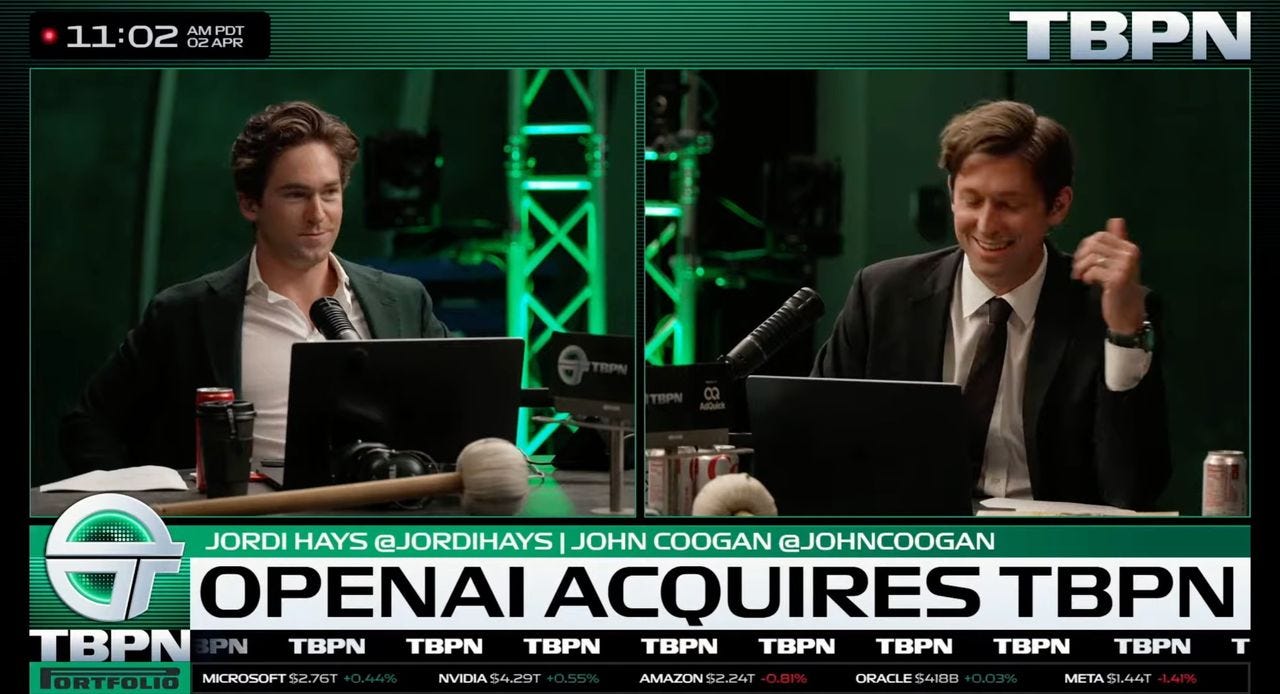
OpenAI Just Bought a Podcast. Here's the Part That Should Worry You.
What TBPN is, the deal basics, the Lehane reveal, the structural independence problem, the Anthropic contrast, what this means for founders consuming AI media!
OpenAI just acquired TBPN. a daily live tech talk show hosted by two ex-founders, John Coogan and Jordi Hays. It’s only 18 months old, pulls around 70,000 viewers per episode, and had Zuckerberg and Satya Nadella on as recent guests. OpenAI paid low hundreds of millions for it.
On the surface it looks like a media bet. Scroll past the headline and it gets more interesting.
The first thing to notice is who’s running it.
It doesn’t sit under a CMO or a media team. It reports to Chris Lehane - OpenAI’s chief global affairs officer.
A quick look at his background tells you everything:
Clinton-era political operative, nicknamed “the master of disaster”
Helped Airbnb fight housing regulators city by city across the US
Built Fairshake - the crypto industry PAC that spent $130M targeting anti-crypto lawmakers in 2024
Now runs Leading the Future - a $100M pro-AI super PAC already targeting state legislators who support AI safety bills
This is not just a media acquisition. It’s a political operation with a talk show attached.
OpenAI then went ahead and announced an “Editorial Independence Covenant.”
Sam Altman even wrote publicly: “I don’t expect them to go any easier on us.”
BUT here’s what no covenant can change:
TBPN’s ad revenue was shut off the day the deal closed
The hosts now hold OpenAI equity
Every future guest, CEOs, founders, or competitors, all will calibrate what they say knowing who signs the cheques.
The timing is no accidental either.
OpenAI just raised $122B at an $852B valuation and is heading toward an IPO.
At the same time they’re dealing with a #QuitGPT movement over Pentagon contracts, backlash over ads in ChatGPT, and the ongoing Elon Musk trial.
So by buying Silicon Valley’s insider daily show right before going public, Is this pre-IPO reputation management? what they’re doing?
Now lets compare that to what Anthropic has been doing in the same period.
While OpenAI was buying a talk show, Anthropic was fighting the Pentagon in federal court.
They refused to let the DoD waive their restrictions on mass surveillance and autonomous weapons. Got designated a “supply chain risk” , first time that label has ever been applied to an American company. Took it to court. Won a preliminary injunction. You can disagree with their model or their safety positioning, but that’s a company spending political capital on principles rather than on controlling who gets to talk about them.
The bigger issue for you as a founder is this:
the places you rely on to understand the AI landscape are increasingly owned by the companies being covered. And the instinct to wave it away that.
“they promised editorial independence”
is exactly the kind of reasoning that a seasoned political operative like Lehane has spent his career exploiting.
Need a workspace that travels with you?
ATworld gives you co-working, events, and services anywhere in the world.
Use code AJAY39403 to save €50 on your first paid month.
Because here’s what comes next.
OpenAI is heading into an IPO, a Trump-era regulatory environment, and a world where open-weight models are commoditizing their core product faster than most people realize.
The narrative war isn’t a side show, it’s becoming as important as the model war.
So Who gets invited on TBPN, what gets framed as innovation versus risk, which competitors get serious scrutiny versus a friendly chat, all of that shapes how founders, investors, and regulators think about this space.
OpenAI didn’t buy a podcast. They bought the room where Silicon Valley forms its opinions , and handed it to a political operative to run. That’s worth watching closely.
For the full OpenAI acquisition deep dive » Astral, Promptfoo, Statsig, and what the buying spree really tells you about where AI is heading > watch for the next Intelligent Founder deep dive.


