
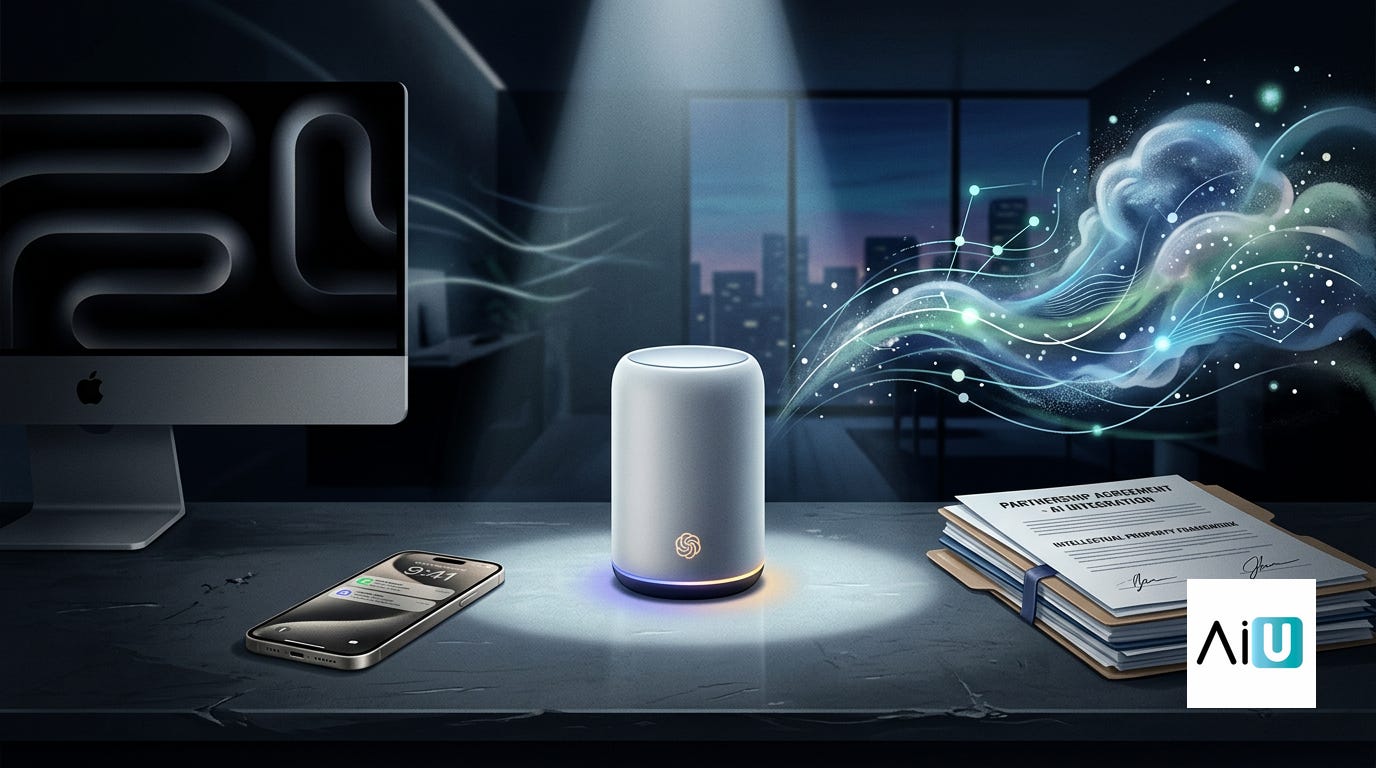
OpenAI’s hardware move: the screenless speaker
How OpenAI’s story contrasts with the rest of the frontier set
Apple says OpenAI stole its future. OpenAI, meanwhile, is busy trying to build a future where the primary interface to computing isn’t a phone at all, but an always‑on agent that lives in your home and inside your work tools. we unpacked Apple’s paranoia about losing control over the next interface shift, earlier in “The Great AI Heist” ( link below ), in this is post, we’ll look at OpenAI’s side of the table.
how a model company turns into a hardware + agent company and
why that’s worth picking a fight with Cupertino over
OpenAI’s side of the story is basically: “we’re not just a model company anymore. we’re building a hardware + agent stack that lives in your home and inside your workflows, and we think that’s how we beat everyone from SpaceX to Apple.” Okay. 🤔
Bloomberg’s reporting has OpenAI’s first device as a portable, screen‑free smart speaker designed to be a “humanlike AI companion” that sits in your home. It’s meant to control your smart‑home kit, play media, answer questions and messages, and act as a kind of ambient “home computer” for the AI era, i.e. a ChatGPT without the rectangle of glass. The speaker reportedly packs sensors and mechanical elements that can move, turn, and respond to you, plus a rechargeable battery so it can follow you around the house. Internally, the pitch isn’t “we built Alexa 3.0,” it’s: we gave the agent a body.
That’s exactly what makes Apple’s lawsuit existential from OpenAI’s point of view.
Apple isn’t just upset about staff attrition. it’s arguing that OpenAI’s hardware stack - design language, supplier map, roadmap all of which has Apple DNA baked in and should be frozen or unwound by the courts.
For OpenAI, the speaker is a wedge - basically a way to stop being purely dependent on iOS and Android surfaces and instead own a new interaction surface outright. If the agent lives in a device you control, not just inside another company’s operating system, you get to define the experience and the economics.
“If you were watching the OpenClaw experiments on Mac minis in January, you were looking at the dress rehearsal for OpenAI’s hardware play. The roadmap was already a year old; the rest of us were just catching the tail end—the phase where frontier agents move from dev boxes in the corner to a purpose‑built device on your kitchen counter.”
Under the hood, that hardware move is powered by GPT‑5.6—Sol, Terra and Luna - which OpenAI calls its “most capable system yet.”
Sol is the frontier brain, aimed at long‑horizon reasoning, complex coding and scientific work.
Terra and Luna are tuned for cost and throughput.
The launch came with political theatre:
previewed in June, delayed under U.S. national‑security pressure, then cleared and released on July 9 as a system the Trump administration explicitly signed off on. Open AI’s narrative is very deliberate.
this isn’t just a big model, it’s a strategic asset that ostensibly needs state‑level oversight.
At the same moment, OpenAI rolled out ChatGPT Work:
an agent designed to stay with a project for hours, reach across your apps and files, and turn goals into finished documents, spreadsheets, slide decks and simple web apps. It’s a convergence of ChatGPT and Codex into one work layer, aimed squarely at white‑collar workflows rather than casual chat. Rollout starts with Pro, Enterprise and Edu, then expands to Plus and Business, signalling that OpenAI sees Work as a monetisation and lock‑in lever for organisations, not just another “labs” feature.
Put the pieces together and OpenAI’s gambit looks very different from the rest of the frontier set.
Meta ships Muse Spark 1.1 as a creative multimodal model. Anthropic releases
Claude Sonnet 5 with a safety‑first, constrained‑access posture.
Google sits on Gemini 4, waiting for the right regulatory and competitive moment to move.
OpenAI’s bet is more vertical: a brain (GPT‑5.6), a pair of hands (Work and Codex), and a body (the speaker), all wired into a single stack that can mediate both your home and your workflow
The scenario they’re selling is simple to imagine and at the same time also hard to ignore. a screen-less speaker running GPT‑5.6 Sol and the Work agent overhears a project discussion in your living room, pulls the relevant files from your laptop, and drafts the proposal and slides before you even sit down at your desk. In that world, whoever owns the agent and the box it lives in captures a disproportionate share of value.
Apple wants courts to lock down the box.
OpenAI wants regulators and judges to recognise model behaviour as defensible IP and then race to embed that behaviour in hardware before anyone else can.
For Apple’s side of this mess, and how Anthropic fits in - read The Great AI Heist, then come back here and ask: - in a world of agents with bodies, who’s really stealing whose future?
Few Updates this week-
1- Our AI stack of newsletter - Intelligent Founder AI - hit #88 on Substack’s “Rising in Technology” leaderboard last week, (and #98 in Business earlier this year); huge thanks to everyone who’s subscribed, shared, and sent us ideas to dissect next.
We’re now a 5K-strong community across Intelligent Founder AI and AI Unfiltered, with around 3.3K and 1.5K subscribers respectively, even allowing for some overlap between lists.
2- We’ve moved our quantum technology blog, Quant Opinion, from Medium to Substack so we can manage and publish research more easily in one place. Medium will remain as a syndication channel for all three projects—Intelligent Founder AI, AI Unfiltered, and Quant Opinion - so if you follow us there, you’ll still see every post, not just the quantum ones.
Read the latest on Quantum here and Subscribe to Quant Opinion on Substack for our latest quantum research, analysis, and commentary. -
Latest on Intelligent Founder ai-


