The AI Industry’s Jensen Huang Problem!
An unresolved investigation, a shifting balance of power, and the questions a resignation cannot answer

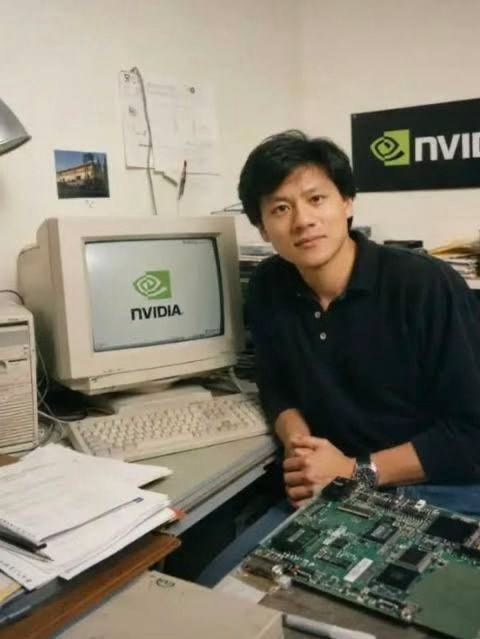
It’s been a while. With the Q4 event calendar almost closed, I should have more time in December to spend across all three publications and post more regularly.
With everything happening in the AI industry globally - and the geopolitical fallout around it - it has been hard to stay quiet, even when I did not want to comment much.
I wrote a short blurb this morning with my Intelligent Founder deep dive about the Nvidia situation and how I see it as a founder. I wasn’t planning to do this one. but the continuous flooding on my timeline I thought I’s should get my own baseline right and stated. I do not think this is an isolated incident, but there are a few observations I wanted to note down.
The internet has already decided what this story means.
Jensen Huang resigned. The affair, the alleged spying, the board investigation, the stock drop, the Trump and Musk reactions, the Steve Jobs comparisons - it has all become a single narrative within hours.
But I am not sure the narrative is settled.
The affair is personal. The alleged espionage is geopolitical. The Megaspeed issue is financial and regulatory. These are three different stories, but the coverage keeps treating them as one.
That is what makes me skeptical.
Not because I think nothing happened. But because I think people are moving too fast from “something happened” to “we know exactly what happened and why.”
The part nobody wants to say
A lot of people are now saying the whole thing was a setup.
I understand why. The timing is strange. The story was known internally for a long time. It escalated right after the midterms. The board acted before the investigation finished. And the most damaging details arrived in a sequence that made quiet resolution almost impossible.
But “it feels staged” is not the same as “it was staged.”
The stronger question is not whether someone wanted Huang out. Someone almost certainly benefited from him being out. The question is who, and whether their motive was national security, political advantage, commercial competition, personal revenge, or something more mundane.
That is the part the internet skips. It wants a villain. But the more interesting question is: who gained power when Huang lost his?
The affair was never the real issue
The affair itself would not normally matter to a company’s revenue. People do not stop buying chips because a CEO had a personal scandal.
But this is not a normal CEO scandal.
The issue is not simply that Huang had an affair. It is that the affair sits next to allegations of foreign intelligence, a major Nvidia customer, export controls, and U.S.–China technology policy.
That changes everything.
Once the board opens a national-security-level investigation, the story stops being about personal conduct. It becomes about whether the industry’s most important company can still be trusted to operate at the center of a geopolitical conflict.
That is a different kind of risk.
The Megaspeed problem
The part that interests me most is not the affair. It is Megaspeed.
Megaspeed was not just any customer. it absorbed billions of dollars in advanced Nvidia hardware through Singapore. It was connected to Alice Huang, the executive at the center of the alleged intelligence operation, and it was already under regulatory scrutiny over whether export-controlled silicon was being diverted into China .
That scrutiny deepened with revelations that Huang held indirect financial stakes and loan guarantees in Chinese data center infrastructure built specifically to serve Huawei Cloud. In an instant, Megaspeed stopped looking like an arm's-length regional reseller and started looking like a direct conduit bridging Nvidia’s premier silicon to its fiercest state-backed competitor.
That is the real issue.
Not “Did Huang have an affair?”
But: Did Nvidia’s reported growth depend on demand that U.S. policy was trying to restrict?
If billions in compute booked through Southeast Asia were backstopping Chinese infrastructure, the market’s understanding of Nvidia’s baseline changes. It would not mean the revenue disappears overnight. It would mean the revenue was always politically fragile.
And in this industry, political fragility is an existential risk.
Why this matters for AI
The AI industry has been running on a simple assumption: build more compute, train bigger models, deploy faster, and the demand will keep coming.
That assumption is now under pressure.
Not because AI demand has disappeared. It has not.
But because the infrastructure behind AI is becoming more political.
Data centers need land, power, permits, and public consent. Chips need export approvals, compliance systems, and geopolitical alignment. Cloud providers need to prove that their compute is not quietly serving restricted markets.
That means the industry can no longer assume that technical progress alone will carry it forward.
It now needs political legitimacy too.
Huang’s role
Huang was uniquely positioned to make that case.
He had credibility. He had relationships. He had a story that made sense: AI is important, compute is essential, and restricting access too aggressively could slow progress or push other countries to build alternatives.
That argument may still be true.
But after this scandal, it becomes harder to make.
Every time Huang or anyone close to Nvidia argues for softer export controls, someone can now ask whether the argument is about national competitiveness or commercial access.
That is a major loss for the industry.
What the resignation means?
Huang’s resignation does not prove the espionage allegations are true.
It does not prove that Nvidia’s business is broken.
It does not prove that the AI industry is doomed.
But it does prove something else: the board decided that the risk of keeping him was no longer worth it.
When the reporting expanded from foreign intelligence whispers to an internal affair with a subordinate executive, the board was handed the textbook corporate-governance lever it needed. They didn’t have to wait for the FBI, the Commerce Department, or Congressional hearings to conclude . They could act immediately/
Splitting Huang’s 33-year grip on the company by installing CFO Colette Kress as interim CEO and appointing an independent chair is the classic institutional playbook . In a company as strategically vital as Nvidia, the founder’s personal exposure had become sovereign risk.
The board does not protect the founder. It protects the company’s ability to operate, raise capital, appease regulators, and maintain political access.
Once that access was threatened, the founder became expendable.
The bigger question
The question is not whether Jensen Huang was right or wrong.
The question is whether the AI industry can survive without its most visible advocate.
For years, the industry has relied on a small number of people to make the political case for AI: more compute, more data centers, more chips, more freedom to operate.
If one of those people becomes politically damaged, the whole industry feels it.
That is what makes this story bigger than Nvidia.
It is about whether the AI industry can still make its case to governments, regulators, and the public when the person making that case becomes a liability.
Will he come back?
People are already asking whether Huang will come back like Steve Jobs did.
Maybe. But that comparison is doing a lot of work.
Jobs returned because Apple needed him and because the board eventually realized it had made a mistake. Huang’s situation is different. Nvidia is not a struggling company waiting for a savior. It is a $4 trillion company at the center of a geopolitical conflict, with regulators, Congress, and intelligence agencies now paying attention.
If Huang returns, it will not be because the internet misses him. It will be because Nvidia decides that the cost of losing him is higher than the cost of keeping him.
That is a very different kind of comeback.
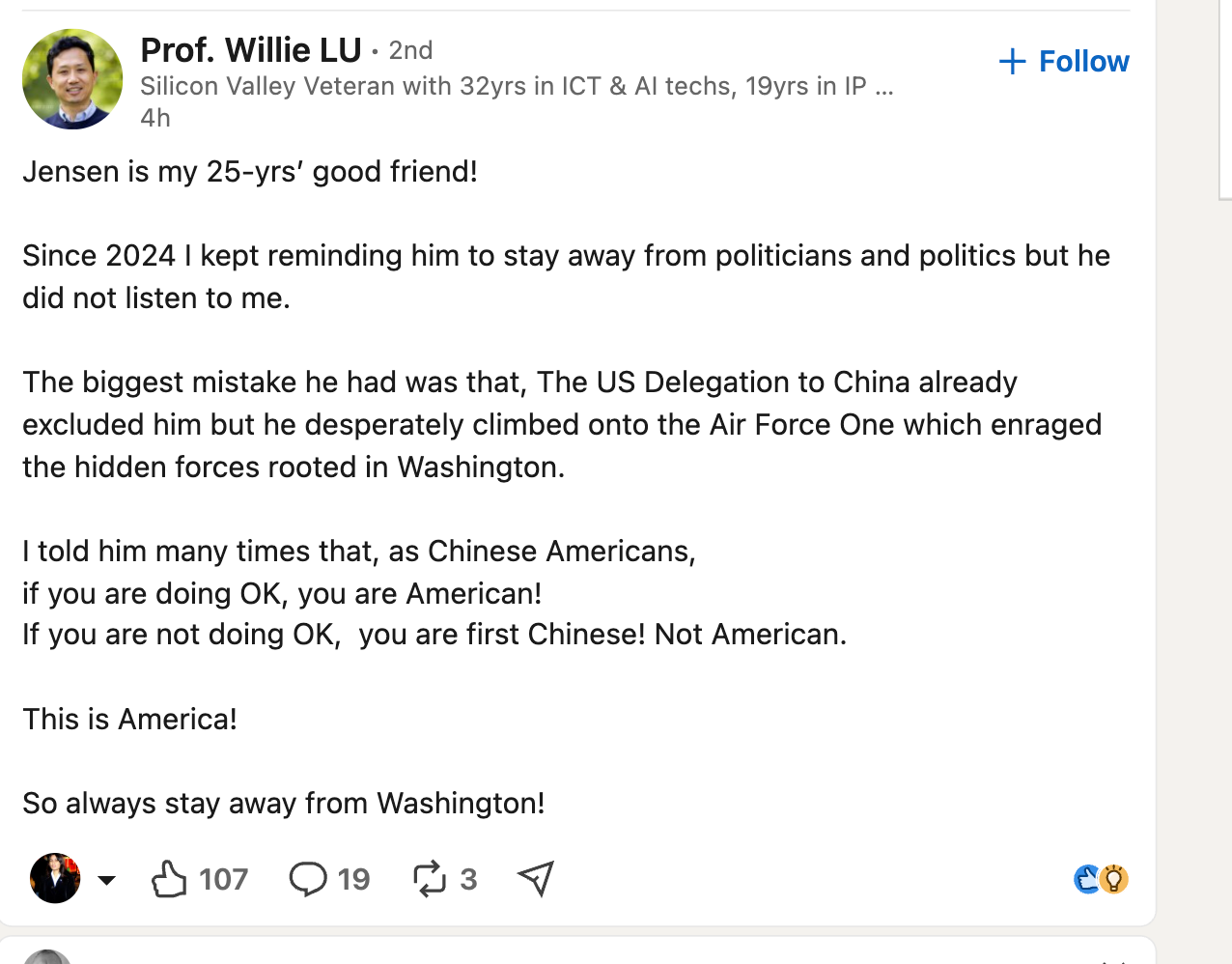
What I think?
In my opinion, the moral outrage surrounding this feels wildly manufactured and blown out of proportion. None of these personal relationships were recent, clandestine discoveries. By all accounts, they were long-standing matters that insiders were well aware of for years. Nobody was “caught” in real time.
The fact that history tolerated during Nvidia’s ascendancy was suddenly exhumed and weaponized as an urgent, zero-tolerance crisis tells you everything.
The outrage was never about an overnight ethical awakening—it was about pulling a lever that had been sitting in reserve until the board and Washington needed an exit ramp.
Personal scandals rarely dismantle sovereign-scale tech empires on their own. They provide the trigger when an institution has already decided it can no longer afford the exposure.
For years, Nvidia’s monopoly on critical silicon granted Jensen Huang unprecedented latitude to challenge Washington’s trade controls, court foreign capitals, and treat the global semiconductor supply chain as his personal diplomatic theater. But an individual’s leverage only lasts as long as state interests and corporate self-preservation align with it.
The moment national security hawks, nervous boardrooms, and Commerce Department investigations converged, Huang transitioned from an indispensable visionary into an untenable liability.
In the end, he became the convenient fall guy for an industry that mistook commercial dominance for diplomatic immunity. Removing Huang allows Nvidia to appease Washington, reset its institutional posture, and insulate its business model behind a more compliant executive structure.
The AI boom spent a decade elevating its founders into modern statesmen, but when the tectonic plates of geopolitics and corporate survival grind together, individual architects are always expendable.
The machinery of compute rolls on - it simply demanded a sacrifice to clear the road ahead.
Latest on Quantopinion and intelligent founder -


Discussion about this post