



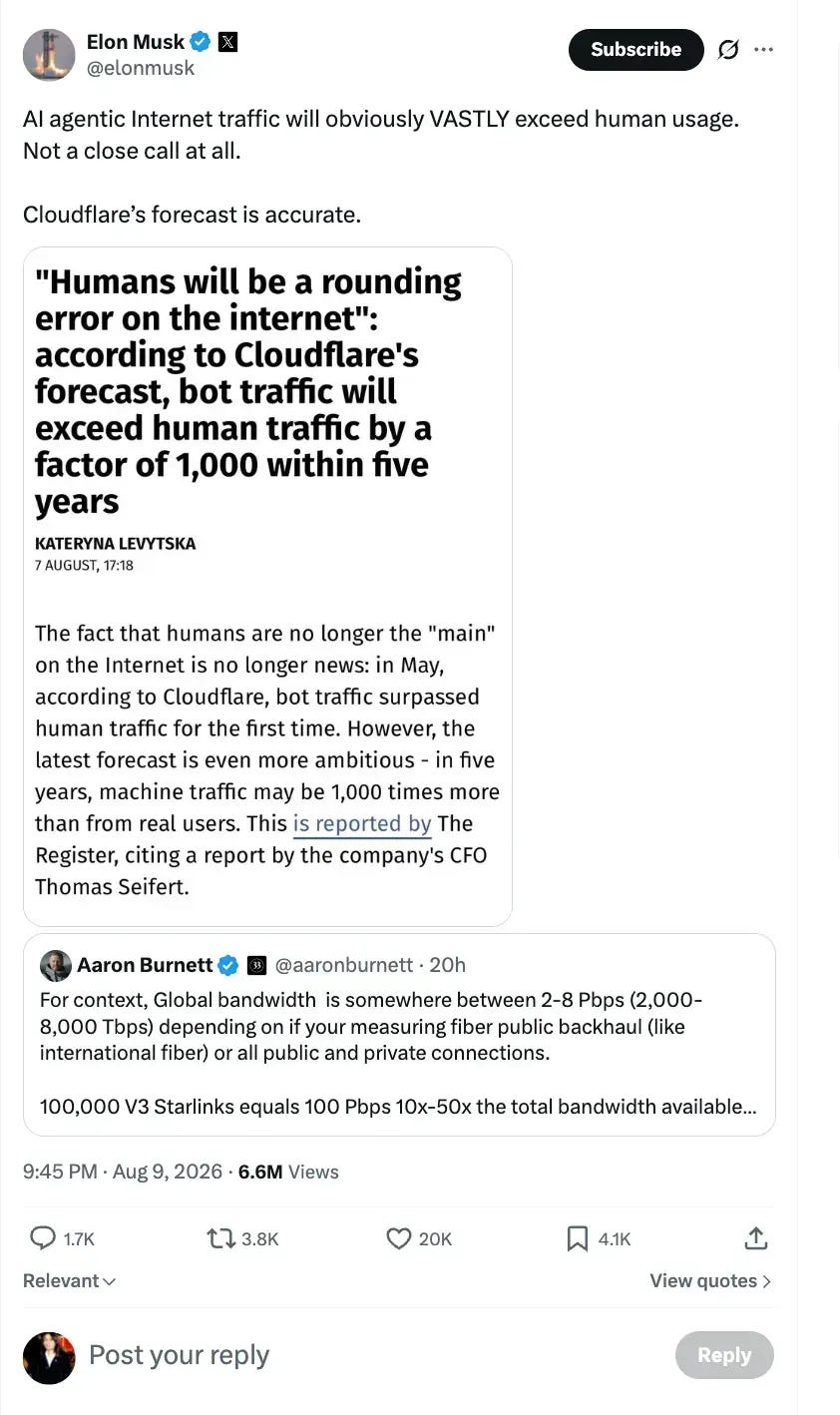
Elon Musk saw a Cloudflare data point and turned it into a much bigger prediction: that AI agents will soon outnumber humans online, while Starlink could carry more than 90% of global IP traffic.
The first claim points to a real structural shift. The second is a leap.
The more interesting story is not whether satellites replace fiber. It is that the web is increasingly being used by software acting on behalf of people and most websites, analytics stacks, and business models were never designed for that.
The Real Story?
Bots crossed the line
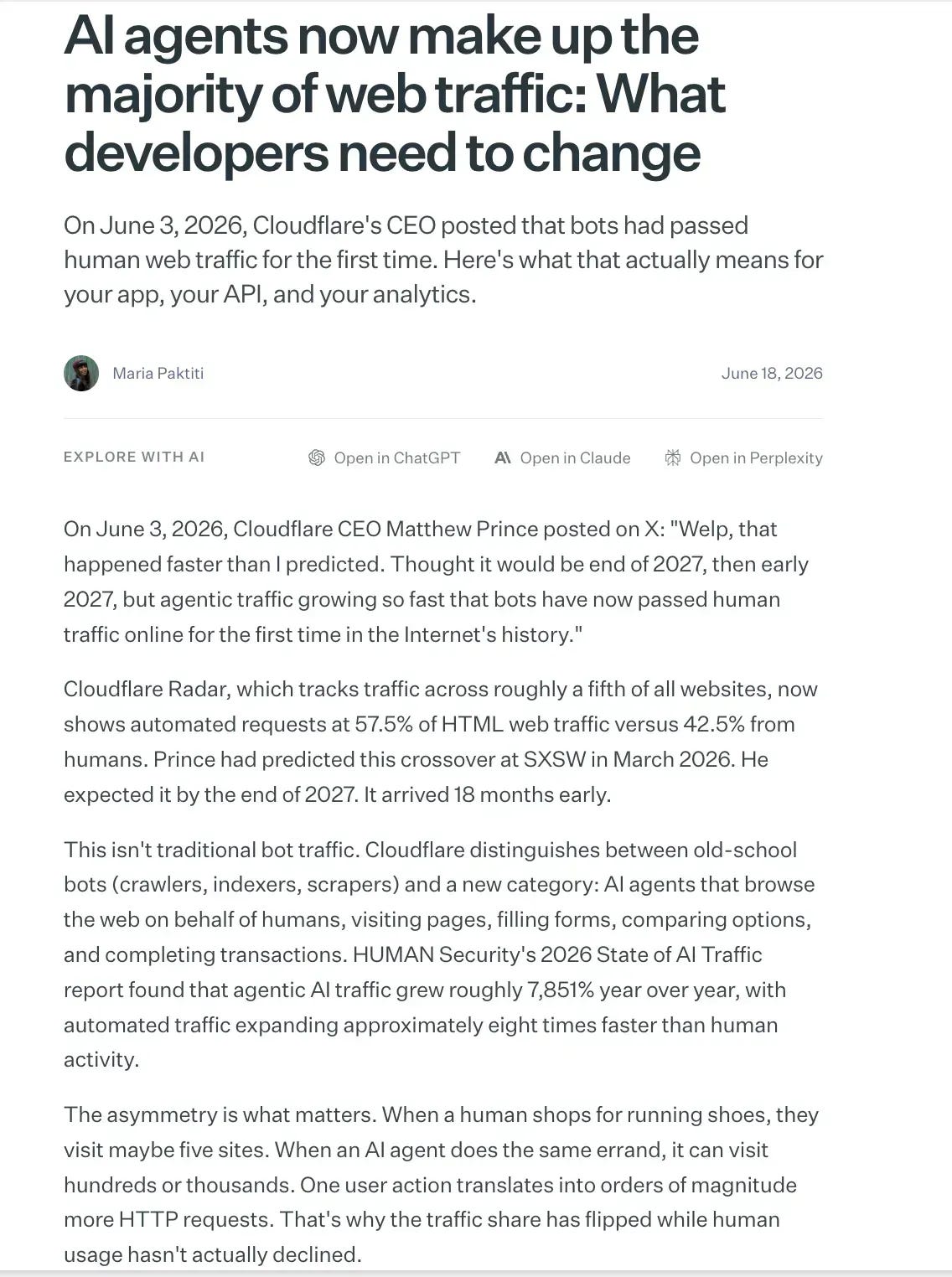
Cloudflare’s traffic data suggests automated systems now account for a majority of HTML requests. That does not mean humans have disappeared from the internet, or that bots consume most internet bandwidth. Video streaming, downloads, gaming, and cloud workloads still dominate the bytes.
But it does mean something important: on a growing share of the web, machines now make more individual requests than people do.
Some of that automation is old-fashioned search crawlers, uptime monitors, ad-tech, fraud systems, and scrapers. The new factor is autonomous and semi-autonomous AI agents: systems that search, compare, extract, book, buy, and execute multi-step tasks for a user.
That changes the shape of demand.
Why Your Infrastructure Is About to Hate You
Because, Infrastructure feels it first
This is not simply a “more traffic” problem. It is a different traffic-pattern problem.
One prompt can trigger a request storm. A person asking an agent to compare laptops, suppliers, insurance quotes, or travel options can generate hundreds or thousands of requests in seconds.
Requests and bandwidth are diverging. Human video consumption still dominates raw throughput, but agents can dominate low-payload, high-frequency request volume—the kind that strains APIs, origin infrastructure, WAF rules, rate limits, and observability systems.
Cost is becoming less predictable. A website built around human browsing patterns may suddenly absorb large volumes of concurrent automated retrieval, often without a meaningful increase in revenue or conversion.
The bottleneck is increasingly not just gigabits per second. It is request concurrency, packet processing, latency, identity, and the cost of serving machine-driven interactions at scale.
The web’s old bargain is breaking
For much of the web, the historic deal was simple: search engines crawled content, then sent readers back to the publisher.
Generative AI complicates that exchange. A model or agent can retrieve a page, extract the useful answer, and return a response without sending the user to the original source.
That is why publishers are starting to ask a harder question: if an AI company trains on, indexes, or repeatedly queries our content, what do we get in return?
The emerging answers are fragmented:
Crawl permissions and bot controls
Licensing arrangements with AI providers
Metered or paid access for machine retrieval
Structured feeds and APIs designed for approved agents
Attribution, referral, and compensation mechanisms
The next web-economy fight is not just about copyright. It is about who pays for retrieval, who receives the downstream value, and whether creators retain any bargaining power when the interface between content and user becomes an AI assistant.
Pageviews are losing meaning
Traditional web analytics assumes that a pageview represents a human visit and that time on page, clicks, and bounce rate indicate intent.
That assumption is weakening.
If an agent visits a site, finds a product specification, checks stock, extracts a price, and leaves in two seconds, conventional analytics may register a bounce. In reality, the machine may have completed exactly the task it was sent to perform.
That is the shift from UX to AX: agent experience.
AX does not replace UX. People still need trustworthy, usable interfaces. But businesses will increasingly need to ask a second question: can an authorised machine reliably discover, understand, and transact with this service?
Websites are becoming agent-facing systems
The next layer of the web is being rebuilt for both people and machines.
Semantic HTML, accessible forms, clean metadata, structured data, predictable APIs, and machine-readable product or service information are no longer hygiene factors. They are distribution infrastructure.
Agent-facing standards and protocols are emerging around browser automation, tool calling, commerce, identity, and payments. The details will evolve, and not every proposed standard will survive. The direction is clear, though: agents will increasingly interact through explicit capabilities rather than brittle screen-scraping.
A good web interface will increasingly have two modes:
A human-facing experience designed for trust, clarity, and conversion
A machine-facing interface designed for permissioned discovery, structured retrieval, and reliable execution
Musk’s weakest claim
The idea that Starlink will carry more than 90% of global IP traffic is where the argument breaks down.
Satellite networks are strategically important. They are valuable for remote access, aviation, maritime connectivity, disaster recovery, defence, mobility, and resilient edge deployments. Starlink has also changed expectations around low-latency satellite broadband.
But global internet traffic depends overwhelmingly on terrestrial and subsea fibre networks. Fibre remains the backbone because it offers extraordinary capacity, low cost per bit, and dense connectivity between the world’s major population centres, cloud regions, and data centres.
The agentic web may increase demand for distributed compute, low-latency routing, resilient access, and edge inference. That can strengthen the role of satellite connectivity at the edge. It does not make fibre irrelevant.
The founder playbook
If you are building software, infrastructure, AI, or deep tech, this is not a curiosity. It is a map of where value is moving.
SaaS and application builders
Build for AX as well as UX. Agents rely on semantic structure, accessible controls, stable flows, and explicit permissions. Treat accessibility, structured data, and reliable form semantics as product infrastructure not just compliance work.
Expose approved capabilities. Do not force every agent to scrape your frontend and imitate a human click-by-click. Where appropriate, provide authenticated, rate-limited, permissioned interfaces for high-value tasks such as search, quoting, booking, account actions, or checkout.
Make transactions machine-readable. Product catalogues, availability, pricing rules, compatibility data, service terms, and checkout flows need structured representations. If an agent cannot understand or safely use your offer, it may choose a competitor it can.
Separate human and automated measurement. Track verified agent requests, task completion, retrieval success, API conversions, referral quality, and cost per automated interaction. A low-duration session may be either abuse or a successful machine transaction; your analytics must distinguish the two.
Infrastructure and security founders
Solve for high-frequency, low-payload workloads. The growth opportunity is not only more bandwidth. It is efficient handling of many small, concurrent, latency-sensitive requests across CDNs, gateways, databases, queues, and observability systems.
Treat agent identity as a core problem. Websites need to distinguish verified, authorised agents from impersonators, abusive bots, and uncontrolled scrapers. This points toward scoped delegated credentials, auditable authority chains, transaction limits, revocation, and policy enforcement.
Build the paid retrieval layer. Content owners need practical ways to price machine access without destroying discoverability. Metered APIs, bot-aware gateways, content licensing, usage accounting, and payment rails for retrieval could become meaningful infrastructure categories.
Deep-tech and hardware builders
The opportunity is not just in data centres. Agentic systems create pressure at the network edge: more inference, more local decision-making, more resilient connectivity, and more demand for low-latency processing close to physical assets.
For industrial and critical-infrastructure deployments, the winning architecture may be hybrid: local sensing and edge inference for immediate decisions, secure structured interfaces for machine-to-machine coordination, and cloud connectivity for model updates, fleet learning, and auditability.
That makes compute density, packet-processing efficiency, optical networking, secure edge hardware, and resilient satellite-to-ground connectivity increasingly relevant. The future stack will not be one network replacing another; it will be a more distributed system designed for machines that act before a human sees a dashboard.
Bottom line
The web did not stop belonging to humans overnight. But it is no longer designed only for humans.
Increasingly, people state an intention and an agent performs the browsing, comparison, retrieval, and transaction. The winners will be the organisations that make their data, services, permissions, and commercial models legible to both humans and authorized machines.

