



The tech-layoff count is already alarming. More than 180,000 jobs reportedly cut globally in 2026, with U.S. technology employers announcing 155,126 cuts through August alone. But those figures are almost certainly incomplete. They record the layoffs companies chose, or were required - to announce. They do not capture the far larger, harder-to-track change happening underneath.
This is the era of the silent layoff.
The role that disappears when someone resigns.
The “temporary” hiring freeze that quietly becomes permanent.
The contractor whose agreement ends without replacement.
The small product team absorbed into a central AI platform.
The employee who finds themselves managed out after an overnight shift in performance expectations.
The graduate role that is never posted because the work is now done by a tool, a smaller team, or someone several time zones away.
Uber’s 3,300 job cuts, PayPal’s global restructuring, Cisco’s planned 4,000 reductions, Oracle’s workforce contraction, Meta’s reported experiments with far deeper team reductions, and thousands of cuts at telecom groups such as T-Mobile and Verizon are the visible part of a wider reset.
The important question is no longer whether technology companies are cutting jobs. They are. The question is whether we are measuring the real scale of the change? or merely counting the redundancies that made it into a press release.
The People Building AI Say Work Is About to Change!
The rhetoric from the people leading the AI race is getting harder to ignore.
Elon Musk has argued that AI and robotics could make work “optional” within 10 to 20 years. on 2 July 2026, he wrote that “AI+Robots will be able to do everything, resulting in universal high income. Work will be optional In his vision, a world of abundant machine labour would make employment more like a choice - comparable, and he says, to growing vegetables yourself when you could simply buy them. It is a sweeping prediction, built on the assumption that capable AI and robots become cheap, widespread and economically transformative.
Sam Altman’s position is more cautious, but not reassuring in the short term. He has said that “many current jobs will go away,” while arguing that new jobs will emerge and that people will find “lots of better ones.” He has also said AI will “definitely impact the job market,” even if he expects society to adapt as it has through previous technological shifts.
Then, in May, Altman pushed back against the strongest version of the alarm: he said AI was unlikely to produce a global “jobs apocalypse” and that it had not yet eliminated white-collar jobs at the scale he had previously feared.
All three statements can be true at once.
AI may not trigger a sudden, economy-wide unemployment event. It may still eliminate or redesign large numbers of specific roles. And companies may use the expectation of future AI productivity - not only the productivity they can measure today - to justify cutting headcount now.
That is the uncomfortable gap between Silicon Valley’s promise and workers’ experience. Leaders describe abundance, new categories of work and higher productivity. Employees experience fewer backfills, thinner teams, contractor cuts, rising output expectations and roles quietly disappearing from the organisation chart.
The question is not simply whether AI will replace every job. It is whether companies will share the gains from AI-driven productivity or use them primarily to operate with fewer people.
The Visible Cuts
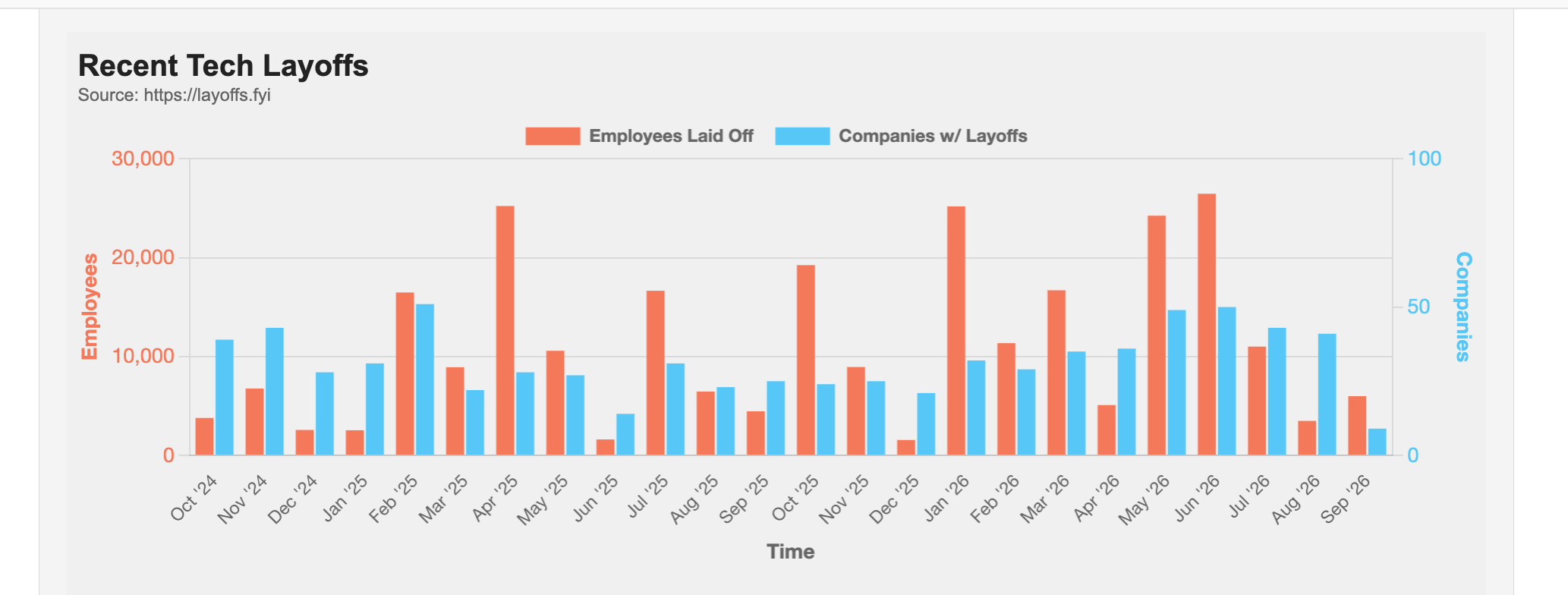
The obvious examples are large enough that nobody can call them subtle.
Uber announced approximately 3,300 job cuts in early September, around 10% of its workforce. The stated rationale was familiar: reduce management layers, eliminate small “micro-teams,” and focus spending on core operations. In plain English, Uber wants a leaner organisation that moves faster with fewer internal handovers.
PayPal has been pursuing a broad global restructuring reported to involve around 20% of its workforce. The cuts have surfaced in several places: 251 planned job losses at its Silicon Valley headquarters, reports of significant reductions in India, and staff reductions in Israel.
Cisco planned to cut roughly 4,000 jobs while shifting resources toward AI. Oracle was reported to be considering further cuts in August, after its workforce fell by around 21,000 - thats 13% over the fiscal year to May.
Meta reportedly considered cutting some teams by as much as 60% as part of an effort to become “AI-native,” before pausing further layoffs. T-Mobile’s six-month layoff tally approached 4,700, while Verizon was reported to have cut 500 roles and closed stores.
And those are just the companies that made the news.
The central point is not that these businesses are failing. Many remain profitable, are investing heavily, or are being rewarded by markets for AI plans. This is what makes the present wave different from a conventional recession layoff cycle.
Companies are cutting people while increasing investment in data centres, chips, models, automation, and AI products.
The Silent Layoff!
Formal redundancy announcements are only the measurable part of the story.
A company can remove hundreds or thousands of roles without calling it a layoff.
It can freeze backfills. It can let contractors go. It can reduce agency spend. It can fold product teams into central platforms, push support work to lower-cost locations, or decide that one AI-enabled employee can now cover work previously shared by two or three people.
It can also make the environment uncomfortable enough that people leave voluntarily.
This is the silent layoff: workforce reduction by attrition, non-replacement, reorganization, performance management, outsourcing, and automation. It is quieter than a mass email from the CEO, but it can produce the same outcome - fewer people doing more work, and fewer opportunities for those looking to enter or move within the industry.
Public trackers almost certainly undercount this.
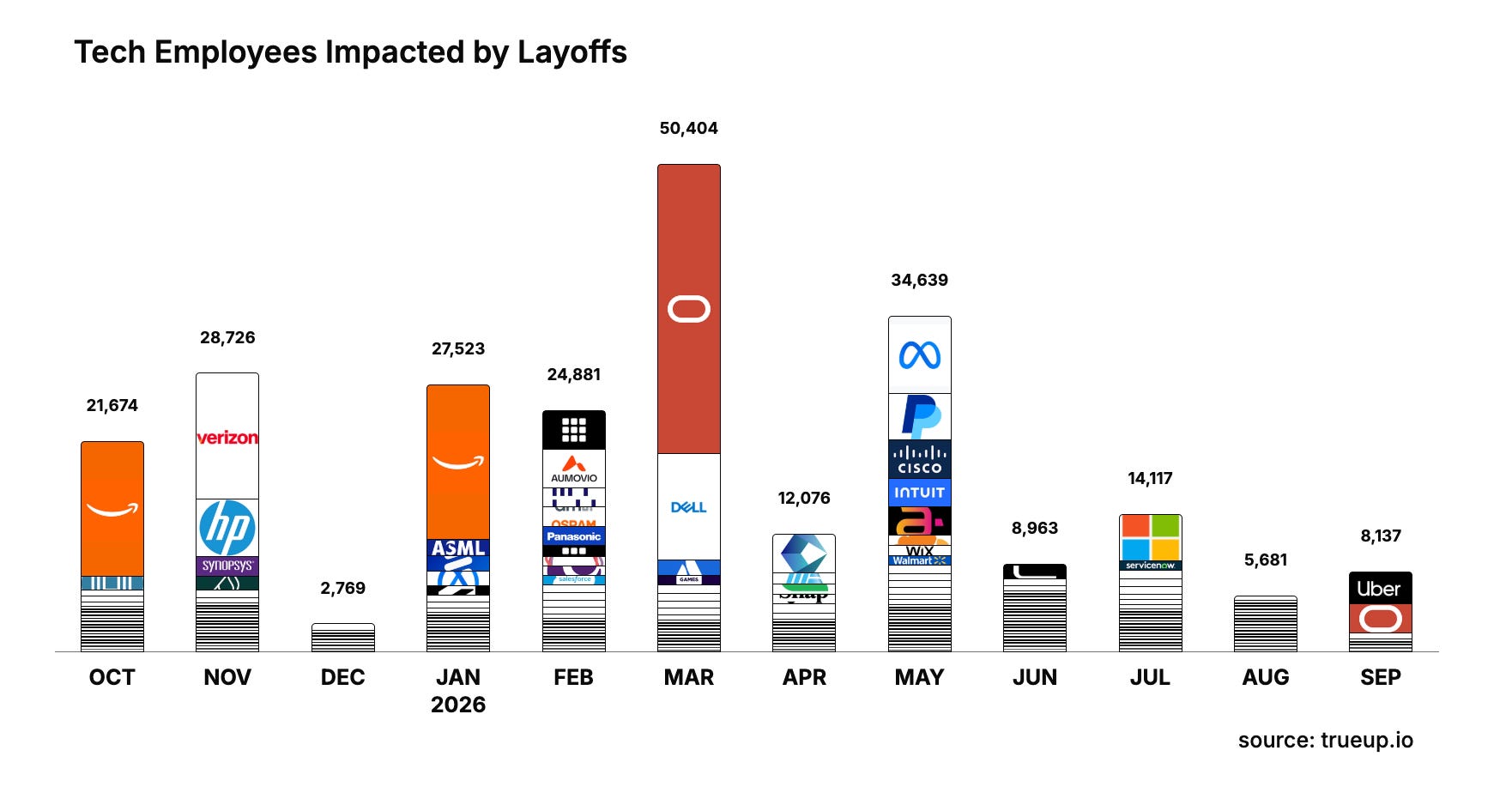
Layoffs.fyi-style datasets rely on reported company announcements. Challenger counts employer-announced job cuts in the United States. Neither dataset can reliably capture the role that was never advertised, the fixed-term contract that ended, or the employee persuaded that their future is elsewhere.
That matters because technology companies increasingly have an incentive to shrink without drama. Public layoffs attract negative attention, damage employer brands, and can make recruitment harder later. Quiet attrition looks cleaner in an earnings call.
Is H2 Getting Worse?
The answer is more nuanced than the headlines suggest.
The year’s layoffs were heavily front-loaded. Layoffs.fyi data cited in reporting put around 81,700 tech job cuts in the first quarter alone - the highest quarterly total since early 2023. By 6 August, 125,759 technology workers had been laid off across 264 companies, already above the tracker’s entire 2025 total of 122,606.
Cuts have clearly continued through the second half. The global total rose above 175,000 by late August and above 180,000 by early September. Uber’s 3,300 roles, the continuing PayPal restructuring, Oracle’s further reductions, and ongoing telecom cuts all show that the wave has not stopped.tech.yahoo+1
But the available monthly data does not yet prove a smooth H2 acceleration.
Challenger recorded 6,103 technology cuts in August, its lowest monthly tech total of 2026. That does not mean the danger has passed. It means the pattern is lumpy: fewer announcements one month, then a major restructuring the next.
The better description is not “the tech industry is collapsing.” It is “the tech industry is redesigning its cost base.”
AI Is Part of the Story - But Not All of It!
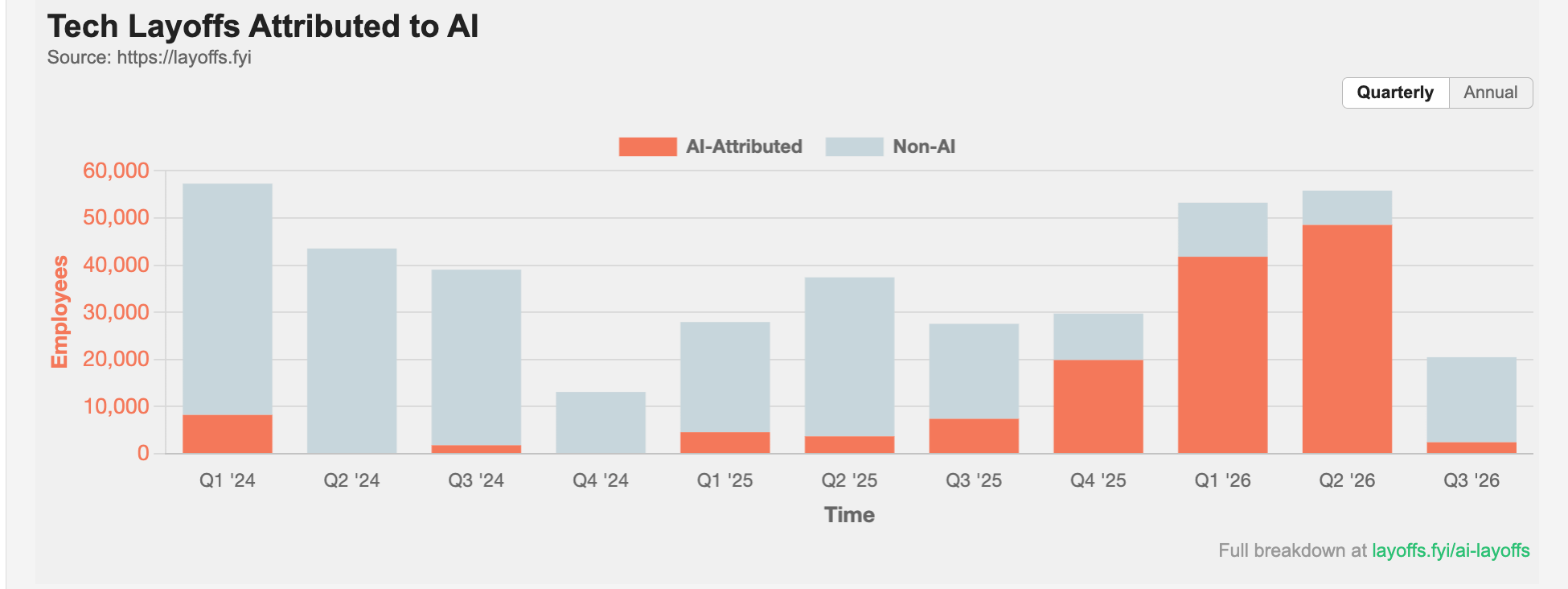
AI is the most visible explanation, and sometimes it is real.
Executives are openly arguing that automation can reduce routine work, flatten management layers, improve developer productivity, automate support, and make internal operations cheaper.
But “AI” also offers a useful corporate narrative for choices companies already wanted to make:
cut duplicated teams after acquisitions,
reduce expensive middle layers,
close unprofitable product lines,
concentrate budgets on cloud and infrastructure, and
improve margins after years of expansion.
The real dynamic is an AI-capex trade-off. Firms are spending billions on compute, data infrastructure, chips, model development, and AI product integration. If they want to protect margins at the same time, headcount is one of the few major cost lines they can move quickly.
That is why a company can announce layoffs and AI hiring in the same quarter without contradiction.
What to Watch Next?
The next phase may be less visible than the last.
Watch for falling job-posting volumes, missing backfills, consolidation of product and operations teams, cuts to contractors and consultancies, tighter performance processes, and language such as “simplification,” “fewer priorities,” “span of control,” “efficiency,” and “AI-native.”
Those phrases often arrive before the number.
The 2026 data shows that tech layoffs are not a passing social-media narrative.
They are a material restructuring trend. But the more important number may never appear on a tracker: how many roles are quietly removed before they have a name, a job advert, or a severance package.
Latest on IntelligentFounder.ai & Quantopinion.ai

