
When a Startup Reaches Orbit, the State Is in the Story!
India’s first private orbital launch maps out how governments can back deep‑tech startups while proving a point on public–private partnership.
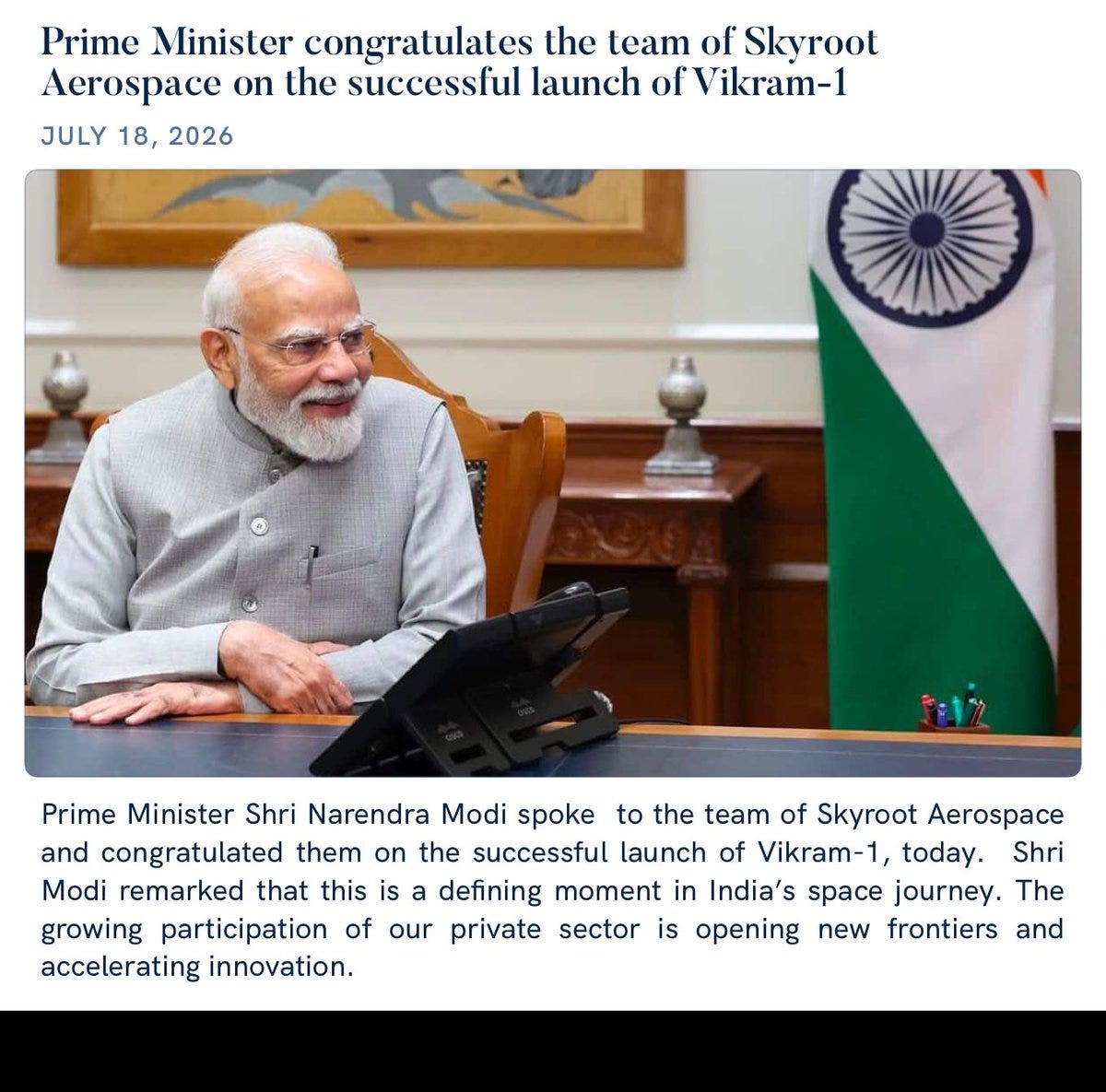
India’s Vikram‑1 launch (Skyroot Aerospace) has been framed as a feel‑good story about a young team, a private rocket, and a nation joining the US and China in having a startup reach orbit. As founders watching from the sidelines, it’s easy to read the headlines, compare them to Elon Musk’s three Falcon 1 failures, and conclude that this is mainly about hustle, bravery and “28‑year‑olds beating the odds.”
This essay takes nothing away from that achievement. Instead, it tries to add a layer:
if you’re building deep‑tech in India, the UK or anywhere else, you should understand the strategy underneath - how India’s state is consciously backing private launch startups to prove a point about public–private partnership in space.
The PR story is good - and mostly true
The public narrative has three main beats:
A team with an average age around 28 built India’s first privately developed orbital rocket and reached orbit on its first attempt.space+3
India becomes the third country, after the US and China, where a private company has independently developed and launched an orbital rocket.space+3
Elon Musk’s Falcon 1 failed three times before reaching orbit, so Skyroot’s first‑shot success is held up as evidence that India’s young founders and new space policy have “levelled up” the game.
For Indian founders and engineers, that’s energizing. It signals that serious hardware is now a legitimate startup domain, not just something you do inside a national lab if you’re willing to wait a decade.
( Do Note - I don’t agree with this kind of writing - “while you were scrolling” here. but I understand its more common and usual than one would want, specially across all the writing and distribution channels including substack specially headlines like “if you are doing this X way - You are doing it Wrong” ) well anyways! my point just highlighting the hype / PR point.
And it is a good sign:
it means the talent that built rockets inside ISRO now has a credible startup path, and global investors are willing to underwrite that risk.
But Vikram‑1 didn’t appear in a vacuum

What the PR doesn’t emphasize is the deliberate scaffolding that made this possible.
Since 2020, India has systematically opened its space sector to “Non‑Government Entities” (NGEs), created IN‑SPACe as a single‑window nodal agency, and formalized the 2023 Indian Space Policy to enable end‑to‑end private participation in satellites, launch vehicles and related services.
ISRO was told explicitly:
focus on science and frontier tech, while commercial and applied tasks move increasingly into private hands.
In practical terms this means:
Private startups can design, test and launch their own rockets, but do so on top of ISRO’s infrastructure: launch pads at Sri harikota, propulsion test stands, tracking and range assets.
IN‑SPACe authorizes, “hand‑holds” and promotes these missions, acting as a state partner rather than a distant regulator.
Policy reforms and FDI changes explicitly aim to pull in global capital and grow India’s space economy from single‑digit billions to several tens of billions by 2033, with private companies playing a leading role.
SkyrootA is not an outlier here.
it is the intended proof point of this architecture.
Young founders, yes - but on a state‑built launchpad
Skyroot’s founders left ISRO in 2018 and set up a private company, raising venture funding from institutional investors including Temasek and GIC. They then built Vikram‑1 as an “almost entirely indigenous, largely 3D‑printed and carbon‑composite platform,” and brought it from drawing board to launch pad in about six years.
That’s genuinely impressive. But crucially:
They launched from ISRO’s Satish Dhawan Space Centre, not a privately built spaceport.
They validated their propulsion and structures using test infrastructure made accessible by state decision, not by leasing a random field and hoping regulators would catch up later.
Their regulatory interface was IN‑SPACe, whose mandate includes promotion and guidance, not just licensing and penalties.
So the story is neither “heroic founders in spite of the state” nor “state rocket with a private badge.”
It’s a consciously designed partnership, where the younger, leaner entity takes market and execution risk, and the state lowers structural barriers by opening its infrastructure and shaping a permissive policy environment.
Is there anything “new” in the rocket itself?
Technically, Vikram‑1 is a small‑lift, four‑stage orbital launcher:
three solid stages and a liquid, restartable orbital adjustment module, able to carry roughly 350 kg to a 450 km low Earth orbit. ISRO’s SSLV, developed on the public side, is a four‑stage small‑sat rocket with solid stages and a liquid Velocity Trimming Module, capable of about 500 kg to 500 km.
The architecture is evolutionary, not revolutionary.
What is fresh is:
The heavy use of carbon‑composite structures to improve mass fraction in a small‑lift regime.linkedin+3
The reliance on 3D‑printed engines and modular subsystems to compress manufacturing timelines and reduce cost.
The framing of Vikram‑1 as part of a family that can be scaled (Vikram‑2, Vikram‑3) in a commercial, fast‑iteration context.
If you’re a founder, the relevant lesson isn’t “this rocket is unlike anything ISRO has flown,” but “this level of capability can now be executed by a private company under a state‑enabled regime.”
Falcon 1’s failures vs Vikram‑1’s first‑shot success
The anecdote that Elon failed three times before reaching orbit with Falcon 1 is often invoked to dramatise.
Skyroot’s first‑try win. But the more interesting comparison isn’t engineering brilliance vs incompetence;
it’s ecosystem maturity vs frontier chaos:
SpaceX was operating in a much less defined private‑launch regulatory and industrial context, building its own supply chain and launch site almost from scratch.
Skyroot is launching in an era where India has already proven orbital flight repeatedly, has flight‑tested SSLV in the same class, and has written a policy specifically designed to encourage private launch vehicles.
Falcon 1’s failures helped define and force, the ecosystem that now makes companies like Skyroot possible.
Skyroot’s success, in turn, is helping validate India’s bet that you can compress that journey by pre‑building the public–private framework first.
Why this matters for founders?
If you’re a deep‑tech founder looking at India’s Vikram‑1 moment, the key takeaway isn’t to feel “less than” because you’re not putting rockets into orbit. It’s to recognise the pattern:
The PR focus - 28‑year‑old founders, private rocket, comparison to Elon - is good for inspiration and talent attraction.
The strategic reality - a government that opens infrastructure, reforms policy, and encourages institutional capital into hard tech - is what actually makes these stories repeatable.
Founders “like us” should celebrate the win while also reading the footnotes:
this is not a pure market accident. it is a state trying to prove that public–private partnership in space can work, and that private capability can sit on top of public assets without being smothered by them.


