

When Your AI Brain Goes Dark
What today’s Claude outage reveals about AI’s hidden infrastructure risks.

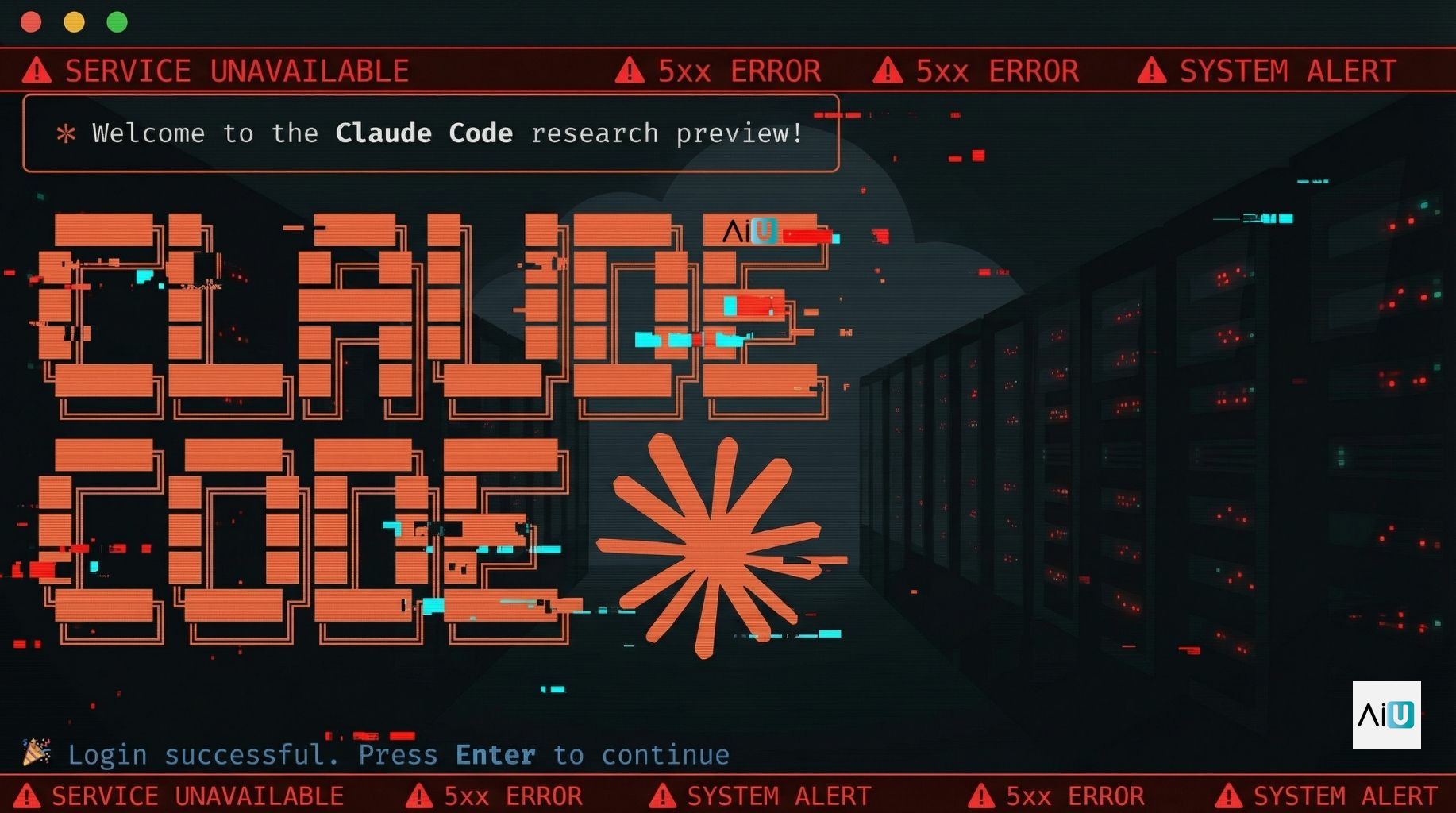
Today’s Claude outage wasn’t just an inconvenience, it was a fire drill that exposed how fragile many AI‑first workflows really are. In a few hours, thousands of users around the world reported errors as Claude Chat, Claude Code and the console stopped working, with 5xx errors and login failures across multiple regions. A lot of people quietly realized they no longer remember how to work without their favorite model.
[ What actually happened »
Claude’s web app, console and Claude Code had a major outage today, locking out thousands of users; API traffic mostly kept working. ]
For a growing number of teams, “AI downtime” now means real downtime. Content pipelines stalled, product work slowed, customer support agents lost their co‑pilot. When one SaaS tool breaks, you can usually switch; when the tool that writes, codes, drafts and reasons for you breaks, there often is no quick replacement if you’ve built everything around it.
That’s the uncomfortable truth today exposed.
The Hidden Risk: Your AI Lives in a Building
Most coverage will say “Claude had a bad day.” The more important layer is however, that these models don’t live in some magical cloud, they live in buildings.
Data centres, power lines, cooling systems, cross‑connects – all in specific regions, with very physical risks.
Recently, an AWS data centre in the Middle East was damaged during regional conflict, forcing power shutdown in one availability zone. Whether or not that is linked to today’s Claude incident, it proves the point:
our “AI brain” now sits inside real infrastructure that can fail, burn, flood, or end up inside a geopolitical blast radius. If you build an AI‑first product, you are also making a bet on those buildings, those grids and those regions behaving as you expect.
At the same time, the big four – Amazon, Microsoft, Alphabet and Meta – are projected to pour roughly 650 billion dollars into AI‑related infrastructure in 2026,
( see this post for the deep dive »
up from around 410 billion last year.
The stack is getting bigger and more powerful, but also more centralized. That combination is great for capability and brutal for systemic risk.
The New Reliability Problem »
One Model = One Point of Failure
There’s also a more mundane lesson here.
Many teams are treating a single LLM as if it were an infallible black box. During today’s incident, the most visible pain was on Claude’s own surfaces – web app, console, Claude Code – while a chunk of API traffic continued to work. If your critical workflows still run through the consumer UI, you are accepting consumer‑grade reliability.
In the weeks leading up to this, one founder even claimed that a brief Claude interruption produced a “90% productivity drop in Silicon Valley.” That’s probably overstated, but directionally right because a surprising number of teams have rebuilt their day around a single AI endpoint.
When a model outage feels like a near‑total work stoppage, the problem isn’t just Anthropic’s uptime, it’s your system design.
Takeaways for AI‑First Teams
If your architecture diagram shows only one LLM logo, you have a single point of cognitive failure.
If you don’t know which cloud regions your main AI vendor runs in, you’re blind to physical and geopolitical risk.
If you haven’t defined a “dumb mode” for your AI features, tomorrow’s outage will be a production incident, not just an annoyance.
Now What Serious Builders Should Do?
If you’re serious about AI, you can’t treat this as passing gossip.
You need a basic “AI reliability” playbook. In plain language:
Stop treating one LLM as a magic box
Have at least two models wired in (for example Claude plus another vendor, or Claude plus a local model) behind a thin abstraction and simple health‑checks. When the primary fails, you should be able to route to a backup automatically instead of scrambling.Design your “dumb mode” on purpose
Decide what every AI feature does when the smart model is down: show cached results, fall back to simpler rules, or hand off to a human. A graceful “it still works, just less fancy” experience is far better than a spinner and a 500.
Watch AI like any other production dependency
Log AI errors separately, track latency and failure rates, and alert on unusual spikes. When an outage hits, write a short incident report and update your run book, the same way you would for a database or API failure.Interrogate your vendors
When you buy AI‑powered tools, ask basic questions: which models do you depend on, which clouds and regions do you run in, and how do you keep serving me if that model or region goes offline? If they can’t answer clearly, you’re taking on more risk than you think.
The real lesson from today isn’t “Claude had a bad day.” It’s that AI has quietly become critical infrastructure, with all the messy hardware, politics and failure modes that go with that. The teams that win this next phase won’t just have the smartest models – they’ll be the ones who assume outages and shocks are normal, and design systems that keep working when their favourite model disappears.