



I did this one reality check episode earlier this year, as I was going through multiple industry reports such as McKinsey, Deloitte, Stanford, Gartner, and NVIDIA all publishing their AI outlook and I thought it’ll be a good idea to see whats actually happening 6 months down the line.


At the start of 2026, the consensus was broadly right: frontier models would keep improving fast, while real economic adoption would move at the pace of procurement, infrastructure, regulation and operational trust.
Six months in, and that is exactly what has happened.
AI is no longer constrained mainly by model capability.
It is constrained by megawatts, integration, governance and the painful work of turning an impressive demo into a reliable production system.
This is the same shift I explored earlier in a deep dive. The 2026 AI Operating System: Stop Shipping Demos, Start Building AI Operating Systems
Lets take a quick look and I’m adding few articles from the earlier this year for a deeper look wherever possible.
The scorecard
The headline is simple as expected.
the infrastructure build-out continues, enterprise AI budgets are becoming more disciplined, and the market has started rewarding operational usefulness over generic intelligence.
Quick check on all areas and what the highlight were.
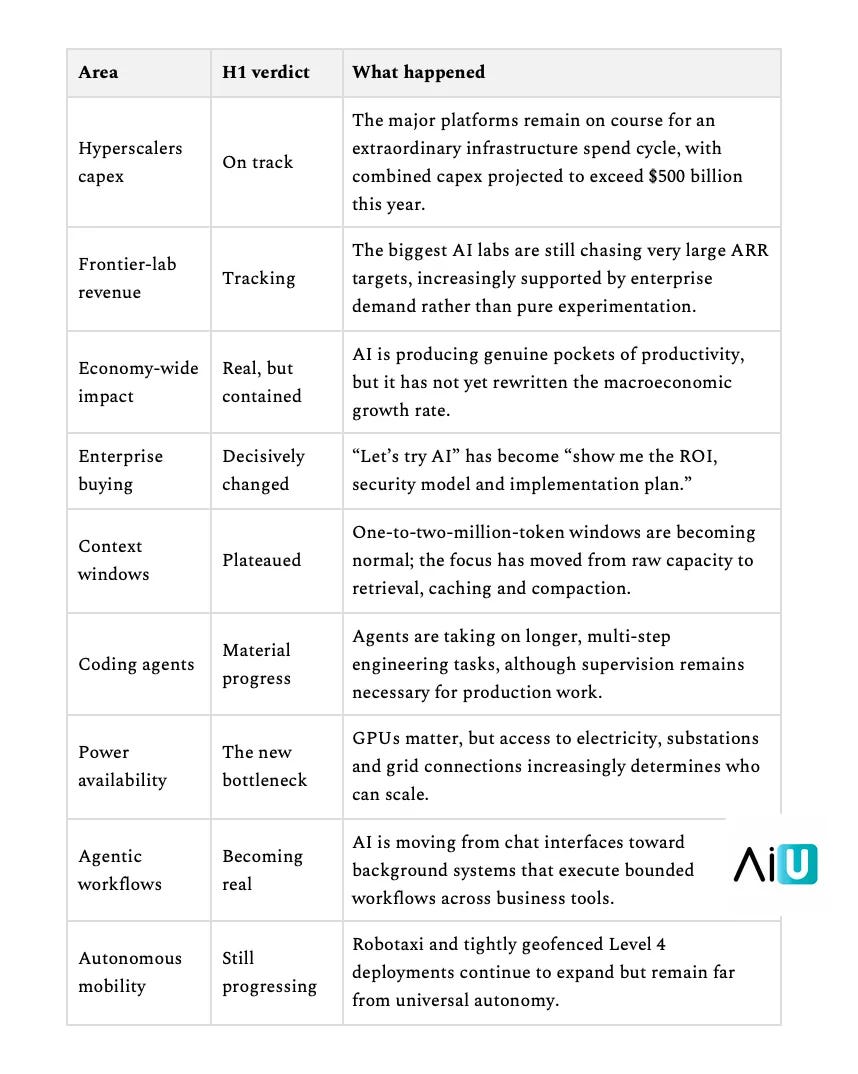
From Leaderboards to Workloads: A Practical View on Model Quality directly reinforces that production workloads, not benchmark scores, are the real test.
The broad lesson?
the AI narrative is getting less magical and more industrial. That is a healthy shift.
The biggest miss: MCP
One forecast that missed it badly was - that the Model Context Protocol would fade away as a temporary abstraction layer.
It did the opposite.
MCP became a meaningful interoperability standard, with governance moving to the Linux Foundation’s Agentic AI Foundation alongside OpenAI, Microsoft, Block and Google DeepMind.
How are AI agents actually being used? This New AISI MCP paper has some answers
Why did the prediction fail?
Because it assumed models would reliably inspect arbitrary API documentation, infer the correct tools, negotiate authentication and execute actions safely every time.
Anyone who has deployed systems in the real world knows that this is not how reliable infrastructure gets built.
The protocol also evolved.
Stateless updates reduced the need for heavyweight session handling, making MCP more compatible with lightweight and server-less deployments. Standardized tool interfaces are simply easier to operate, secure, audit and support than bespoke integrations created afresh by every model invocation.
what mattered the most? - interfaces, conventions and operational reliability, and rightfully so.
What changed?
Context is now an engineering problem
The race for enormous context windows has reached diminishing returns. Throwing tens of millions of tokens at every task is expensive, slow and often counterproductive.
The better pattern is selective context.
retrieve what matters,
summarize what does not,
cache durable state locally, and
compact the working set aggressively.
If your product architecture assumes unlimited context is free, it is not ready for an enterprise P&L.
Power beats compute
For the last two years, the bottleneck was GPU access. Increasingly, it is electricity.
The constraint is moving from silicon supply to physical infrastructure now.. which means generation capacity, grid connections, substations, cooling and clean-energy procurement and the companies that are able to secure power and build efficiently will have an advantage that cannot be replicated by a better prompt.
Agents need bank accounts, and boundaries
As agents move from drafting text to provisioning services, calling APIs and purchasing resources, identity and delegated authority become core product concerns.
An agent needs to know who it is acting for, what it is permitted to do, how much it may spend, which actions require escalation and how every decision can be reconstructed later. “Let the agent handle it” is not a governance strategy.
GenAI Was the Warning Shot, Agentic AI Is the Next Test, best fit for the point that agents create a qualitatively different operational and governance challenge.
Local AI is becoming strategic
Open-weight models running on capable local workstations are reducing the gap with cloud-hosted systems for a growing range of tasks.
For enterprises handling sensitive data, operating in low-connectivity environments or managing variable inference costs, hybrid architectures are increasingly attractive/ local models for routine or confidential workloads, cloud models for the hardest reasoning tasks.
We have discussed this in Episode 13 of If-ai podcast, also the entire Build/Buy/Rent series focusses on infrastructure.
Episode 17 looks at the local AI from commercial perspective.
We also did a deep dive on AI workload placement to weigh the prose and cons of the where should we run AI.
What founders should do?
1. Build for the open ecosystem
Do not make your product a dead-end integration. Support open interfaces such as MCP and portable instruction conventions such as AGENTS.md, then make it easy for customers to connect their existing tools and agent environments
Interoperability is not a philosophical preference. It lowers integration friction, reduces sales resistance and makes your product more useful on day one.
2. Design for compaction, not infinity
Treat context as a scarce operational resource, not an infinite bucket. Build retrieval, summarization, caching, state management and explicit memory policies into the product from the start.
The winning systems will not be the ones that send the most tokens. They will be the ones that send the right tokens.
3. Make governance a product feature
Permissions, audit trails, approval gates, policy enforcement and spend controls should not be an enterprise add-on bolted on after launch.
If an agent can touch production systems, money, customer data or regulated workflows, governance is part of the user experience. Build it into the workflow and make it legible to security, compliance and operations teams.
Some more reading: the infrastructure and governance test side.
4. Sell an outcome, not “AI”
The market is moving sharply away from vague transformation promises. Buyers want a narrow, valuable job completed reliably: an engineering workflow accelerated, a support queue reduced, a compliance process shortened or an operational task removed.
AI Is Eating Mobile, But Not Infrastructure Yet - supports the distinction between consumer attention and genuinely valuable operational deployment.
A product that consistently eliminates 5–20 hours of repetitive, expensive work has a far clearer path to revenue than another general-purpose chatbot.
The H2 test
H1 showed that AI progress is real, but the value is increasingly captured by companies that can integrate models into durable systems.
The question for founders in H2 is not, “How capable is the model?” It is: what operational decision, workflow or constraint can we remove and can we prove it safely, cheaply and repeatedly?